












📅 3 december 2025
📚 BELIEVE HIS PROPHETS
📖 Daily Bible Reading
⚖️ Judges 20 – The Civil War in Israel – When the people of God stand against each other
✨ Broken unity, divine guidance, and painful consequences
🌐 Read online here
🔵 Introduction
Judges 20 is one of the darkest chapters in the Old Testament. It does not describe a war against external enemies, but an internal civil war, a battle within the people of God. A crime in Gibeah – cruel and barbaric – leads to a conflict that almost wipes out the entire tribe of Benjamin.
This chapter forces us to look closely: What happens when the people of God gather in religious unity, but are inwardly shaped by violence, defiance, and pride?
It is not an easy text, but an honest one. It shows: Sin always destroys more than just the offender – it consumes community, trust, and future.
══════════════════════════
🟡 Commentary
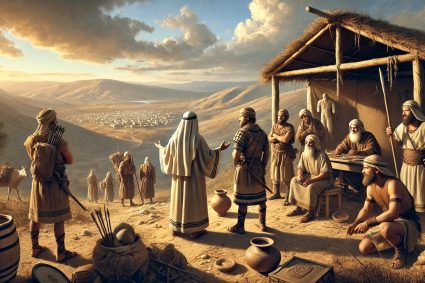
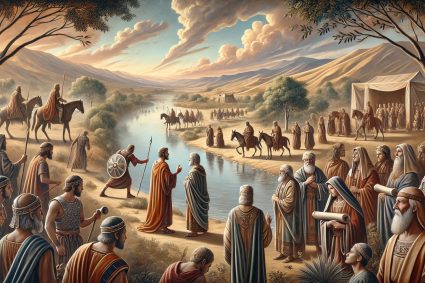
Israel is gathered at Mizpah. Four hundred thousand men stand there – a nation united like rarely before. But this unity does not rise out of joy, but out of shock. A nameless Levite describes the horror inflicted on his concubine in Gibeah. His account is not neutral, but emotional, shocking, and brutal. He cuts her body into twelve pieces and sends them through the land. A terrible message, but it works: Israel wakes up.
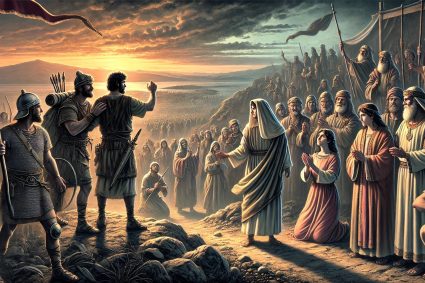
The people demand justice. They ask for the perpetrators from Benjamin to be handed over. But Benjamin refuses. It is not the deed they protect – it is tribal loyalty over moral truth. This “us versus you” unleashes a wave of violence that no one can stop.
Israel asks God: “Who shall go up first?” – and the Lord answers: “Judah.”
But victory does not come immediately. In the first attack, the Israelites lose 22,000 men. They weep, they ask again. God says: “Go up!” But they lose again, this time 18,000.
Why does God allow them to lose twice, even though they are on the side of justice?
The text does not show it directly, but between the lines we read:
Justice does not automatically mean success. Truth does not guarantee immediate results. Sometimes God allows defeat before giving victory – because the people must first learn to weep, to fast, to ask, to wait.
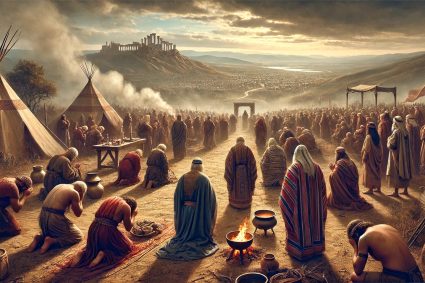
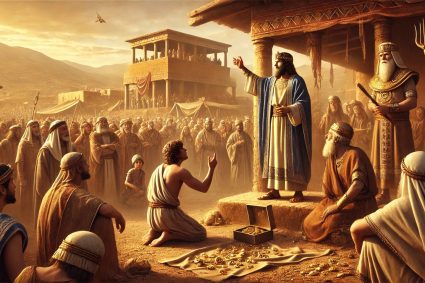
Only when all Israel fasts, seeks the Lord, offers sacrifices, and consults the priests does the turning point come. Then God says:
“Go up; tomorrow I will deliver them into your hands.”
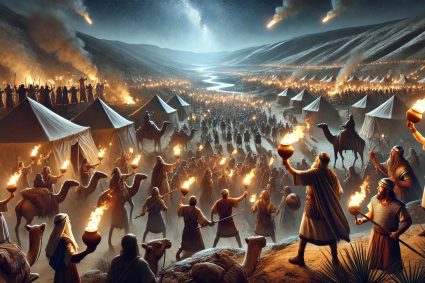
And so it happens. Through strategy, not mere strength: ambush, deception, patience. They lure Benjamin out, just as Benjamin had beaten them before. The city burns, smoke rises – the signal. Finally Benjamin is defeated.
But the victory tastes bitter. 25,000 men of Benjamin die. In the end, only 600 remain, who flee to the rock of Rimmon. Israel destroys entire towns, kills men, women, livestock, even houses. The people who sought justice lose themselves in anger.
Justice has come – but almost without mercy.
══════════════════════════
🟢 Summary
Judges 20 shows a brutal rupture within Israel:
• A crime in Gibeah triggers a tribal war.
• Israel seeks God, yet loses twice – even though the war is just.
• After weeping, fasting, and sacrifice, they listen to God and succeed on the third attempt.
• The victory, however, leads to excessive vengeance and almost wipes out Benjamin.
The story does not end as a triumphal march, but as a tragedy with divine involvement and human excess.
══════════════════════════
📢 Message for us today
-
Justice without humility leads to violence.
Israel sought the right goal – but in the wrong way. The moment of defeat was God’s correction. -
God often works “tomorrow” – not “now.”
We ask: “Why am I losing even though I’m doing the right thing?”
God says: “Weep. Fast. Seek Me. Then act.” -
Tribal thinking is destructive.
Benjamin protects perpetrators simply because they are “one of us.” We see the same today in churches, politics, society.
Loyalty replaces truth – and justice dies. -
Even just wars leave wounds.
Israel wins – but almost at a cost they later regret.
Chapter 21 shows: They weep over their own victory. -
God sometimes lets us experience defeat so we will not become like the offenders.
The first two defeats made Israel soft, humble, praying, asking.
══════════════════════════
💬 Thought prompt
“Before you fight for justice – fight first for humility.”
“Don’t ask only: ‘Am I right?’
Ask also: ‘Am I right in spirit?’”
Maybe you are in a conflict in which you know: “I am right.”
But being right does not automatically mean you are fighting in God’s way.
This text invites us again and again to return to:
• Fasting
• Weeping
• Asking
• Listening
• Waiting
So that our victory does not become a defeat for our soul.
~~~~~ ⚖️ ~~~~~

