🤝 7. As We Also Forgive Our Debtors
“…as we also forgive our debtors.”
Matthew 6:12 — second part
🕊️ A Story — the Unpayable Debt
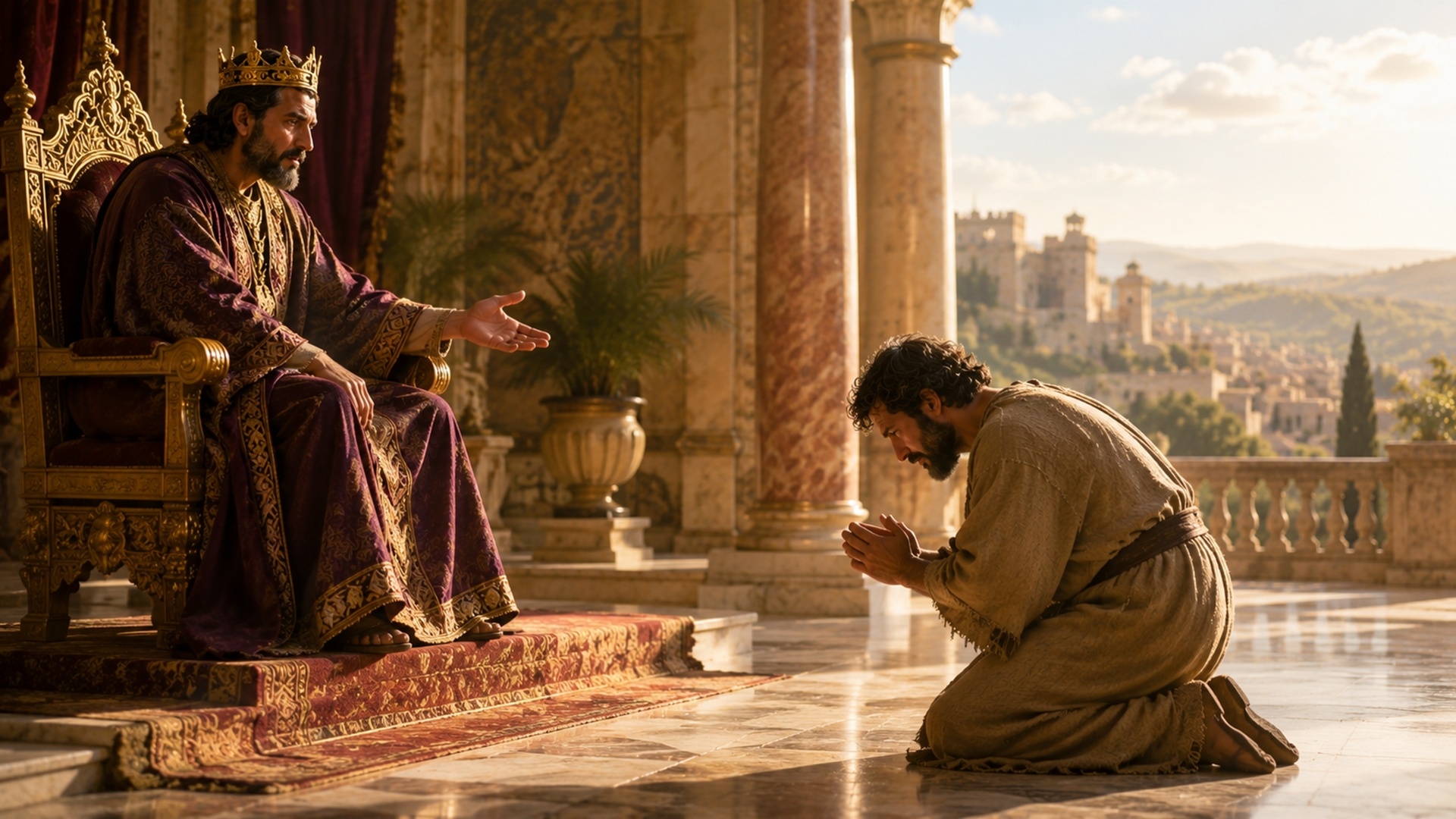
A man stood before the king. The situation was hopeless. The debt he had accumulated was so great that there was no possibility of repaying it. It was no longer a sum that could somehow be settled; it was a burden beyond all measure.
The king summoned him, and when the man stood before him, it became clear what would follow: sale, loss, and consequences. Everything seemed decided.
But then something unexpected happened.
The man fell to his knees and pleaded for patience. He asked for time, for a chance. And the king responded differently than anyone would have expected. He did not merely let him go; he forgave the entire debt.
Completely.
The man walked away free.
But shortly afterward, he met another man who owed him a comparatively small amount. He seized him, pressured him, and demanded what was owed. When the other man pleaded for patience, he showed no mercy. He had him thrown into prison.
When the king heard what had happened, he had the man brought back. The words he spoke were serious:
“Should you not also have had mercy on your fellow servant, just as I had mercy on you?”
(Matthew 18:33)
The story does not end quietly. It reveals a tension that cannot be ignored.
🌿 Forgiveness That Continues
After Jesus teaches us to ask for forgiveness, He adds something that is not secondary. He connects the forgiveness we receive with our willingness to pass it on.
This is not an additional thought. The two belong together.
Anyone who experiences forgiveness faces a decision: What will happen to what they have received?
Ellen G. White describes this connection in the following way:
“The forgiveness we receive from God is not meant to stop with us. It changes the heart and enables us to forgive others as well. Whoever truly understands God’s grace will pass it on.”
(Ellen G. White, Thoughts From the Mount of Blessing, chapter “The Lord’s Prayer”)
She continues:
“A heart that is unwilling to forgive closes itself to the experience of divine forgiveness. For forgiveness is not only a gift, but also an attitude that shapes the whole of life.”
(Thoughts From the Mount of Blessing, chapter “The Lord’s Prayer”)
🔥 Why Is Forgiveness So Difficult?
Forgiveness is one of the most difficult things in life. It does not require us to approve of wrongdoing, but it does call us to release what keeps us bound.
We often hold on—to what happened, to words, and to wounds. Sometimes because holding on makes us feel protected. Sometimes because we do not know how to let go.
But this is precisely where the tension arises. A heart that clings to hurt remains bound.
This request in the prayer brings us to this point: Just as I receive forgiveness, I am invited to pass it on.
🌙 Forgiveness Changes Our Perspective
Forgiveness does not mean that everything is forgotten. Nor does it mean that trust is restored immediately. But it changes our inner perspective.
It breaks the bond that ties us to the wrong and opens a space for freedom.
Ellen G. White writes:
“When a person becomes willing to forgive, a change takes place within. Bitterness loses its power, and in its place comes a peace that does not arise from human strength.”
(Thoughts From the Mount of Blessing, chapter “The Lord’s Prayer”)
This change often does not happen all at once, but step by step.
🌾 The Sabbath as a Place of Reconciliation
The Sabbath is not only a day of rest, but also a day on which God desires to heal our relationships. He invites us to pause and open our hearts, not only before Him, but also toward those around us. True fellowship with God cannot be separated from a life that is willing to seek peace.
When we pray, “…as we also forgive our debtors,” the Sabbath leads us into a special school of grace. On this holy day, we remember how much God has forgiven us. The more deeply we recognize His mercy, the more our view of those who have hurt us begins to change.
The prophet Isaiah describes the Sabbath as a day of joy and fellowship with God (Isaiah 58:13–14). Wherever God is present, the willingness to seek reconciliation also grows. His love opens our hearts to paths that we often could not walk in our own strength.
Ellen G. White writes:
“Whoever enters the presence of Christ recognizes not only the greatness of divine grace, but also the personal calling to become an instrument of peace. The love God gives urges us to show love and mercy to others as well.”
Especially on the Sabbath, we may ask ourselves: Are there relationships that need healing? Are there words that were never spoken, wounds we have carried for years, or bitterness that weighs heavily on our hearts? God does not remind us of these things in order to condemn us, but because He desires to lead us into freedom.
Forgiveness does not mean that wrongdoing never happened or that every relationship can be restored immediately. Some wounds need time, and some boundaries remain necessary. Forgiveness means placing our desire for revenge into God’s hands and leaving judgment to Him. We free ourselves from the power of bitterness and trust that God will act justly.
The Sabbath gives us space to begin this journey consciously. Without the pressure of everyday life, we may examine our hearts and ask the Holy Spirit to show us the people for whom we should pray, those we need to forgive, or those with whom—when possible—we should seek peace. Not every reconciliation happens in a single day, but every journey of reconciliation begins with a first step.
The Sabbath also reminds us of the future. The Bible promises a kingdom in which sin, separation, and pain will have no place. Every Sabbath points toward that perfect fellowship. When we forgive today, we already reflect something of that coming kingdom. We live according to the principles of heaven in a world still marked by wounds.
Perhaps this is one of the deepest invitations of the Sabbath: not only to find peace with God ourselves, but to become people of peace. Whoever receives God’s forgiveness again and again gradually becomes able to pass it on to others.
In this way, the Sabbath becomes a holy space of reconciliation—a place where God’s love softens hardened hearts, begins to heal old wounds, and teaches us anew to forgive as Christ has forgiven us.
🤲 Invitation
Take time today to be honest. Ask yourself where you are still holding on and where you find it difficult to let go.
You do not have to resolve everything immediately. But you can take the first step.
✨ Prayer
Father,
You have forgiven me more than I can fully understand.
And yet I find it difficult
to forgive others.
You see my wounds,
my thoughts,
and the things I continue to hold on to.
I ask You:
change my heart.
Help me let go
of what keeps me bound,
and give me the strength to forgive.
Not through my own strength,
but through Your grace.
And lead me into a freedom
that I cannot reach on my own.
Amen.