
📆 July 26–August 1, 2026
📚 BELIEVE HIS PROPHETS
📖 Weekly Reading from the Spirit of Prophecy
👑 Ellen White | Prophets and Kings
👑 Chapter 15: Jehoshaphat
🙏 A King Between Human Weakness and Living Trust in God
🌐 Read online here
📍 Introduction
Jehoshaphat ascended the throne of Judah at the age of thirty-five. During his twenty-five-year reign, he sought to walk in the ways of his father Asa and to do what was pleasing to the Lord. His story tells of spiritual renewal, just administration, courageous reforms, and remarkable trust in God. At the same time, it does not conceal his mistakes. Unwise alliances placed him in great danger, yet God’s correction repeatedly led him back to the right path. His faith is displayed most impressively when a mighty enemy army advances against Judah and Jehoshaphat confesses: “We do not know what to do, but our eyes are upon You.”
⋯⋯⋯⋯⋯⋯⋯⋯⋯⋯◆⋯⋯⋯⋯⋯⋯⋯⋯⋯⋯
🧵 Commentary
When Jehoshaphat became king of Judah, a great task lay before him. His father Asa had spent many years of his reign trying to lead the people away from idolatry and spiritual indifference. Jehoshaphat had observed this example from his youth. He knew that a king had to do more than protect borders and administer cities. He also bore responsibility for the spiritual condition of his people.
From the beginning, Jehoshaphat sought the God of his fathers. He did not turn to the Baals or follow the example of the northern kingdom of Israel, which under Ahab had sunk ever deeper into idolatry. While the worship of Baal and the influence of Jezebel dominated spiritual life there, Jehoshaphat wanted to lead Judah along the path of obedience.
The Lord established the kingdom in his hand. Judah brought him gifts, and Jehoshaphat gained wealth and honor. Yet his greatest desire was not to increase his personal possessions. The more secure his position became, the more determinedly he opposed the influences that drew the people away from God. He removed the high places and Asherah poles and cleared from the land what remained of the degrading practices of earlier times.
Jehoshaphat understood, however, that outward reforms alone were not enough. Altars could be destroyed and idols removed, but if the people did not know God’s Word, they would easily return to their former habits. Therefore, the king placed great importance on spiritual instruction.
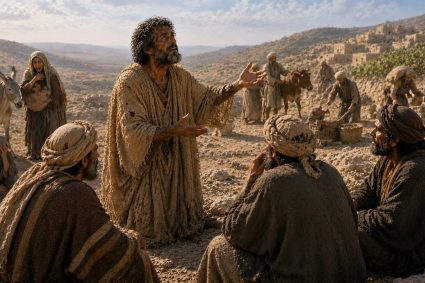
He sent officials, Levites, and priests throughout the cities of Judah. They carried the Book of the Law of the Lord with them and taught the people. City by city, they explained God’s commandments and helped the people understand how to shape their lives according to them. In this way, the Word of God was heard not only in the temple but also reached the various regions of the land.
This measure brought about a spiritual awakening. Many began to understand God’s requirements more clearly. They recognized their sins and turned away from false paths. The law was not presented as a cold collection of rules, but as an expression of the will of a holy and loving God.
Where God’s Word was given room, order, peace, and moral strength developed. People learned to take responsibility for one another. Families were strengthened, public life received a more dependable foundation, and the nation realized that true security did not lie only in walls or weapons, but in faithfulness to God.
For many years, Judah lived in peace. The surrounding nations did not dare attack because the fear of the Lord was upon them. The Philistines brought tribute and gifts, and great flocks came from Arabia. Jehoshaphat grew increasingly powerful and built fortresses, store cities, and fortified places.
His army was also well organized. Valiant men stood ready to serve the king, and the fortified cities were carefully secured. Everything indicated that Jehoshaphat was experiencing an exceptionally successful reign. Spiritual renewal, economic prosperity, political stability, and military strength went hand in hand.
Yet at the very height of his success, Jehoshaphat made a far-reaching decision. He agreed to the marriage of his son Jehoram to Athaliah, a daughter of Ahab and Jezebel. Through this marriage, a close connection was formed between Judah and the apostate northern kingdom of Israel.
From a human perspective, this alliance may have appeared reasonable. It promised political security and a stronger position against common enemies. Spiritually, however, it was dangerous. Jehoshaphat united his house with a family that promoted idolatry and persecuted God’s prophets.
This connection later brought great suffering upon Judah. Athaliah carried the spirit of her mother Jezebel into the royal house of David. What had begun as a politically shrewd decision opened a door to godlessness whose consequences would extend far beyond Jehoshaphat’s own lifetime.
One day, Jehoshaphat visited King Ahab in Samaria. There he was received with great honor. Ahab slaughtered many sheep and cattle and prepared a royal feast. In this atmosphere of hospitality and recognition, he persuaded Jehoshaphat to join him in going to war against Ramoth Gilead.
Ahab wanted to recover this city from the Syrians. He presented the undertaking as just and necessary. Jehoshaphat agreed too quickly and declared that his people and horses were at Ahab’s disposal. In a moment of weakness, he bound himself by a promise to a plan whose divine approval he had not yet sought.
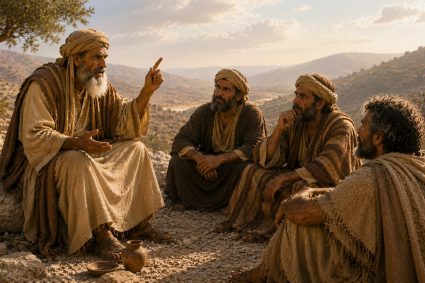
After the initial enthusiasm had passed, Jehoshaphat became uneasy. He knew that such a campaign should not be undertaken on the basis of human calculation alone. Therefore, he urged Ahab first to inquire of the word of the Lord.
Ahab gathered about four hundred prophets. They all declared with one voice that the kings should go into battle, for God would deliver Ramoth into their hands. Their words sounded convincing, and their message corresponded exactly with Ahab’s desire.
But Jehoshaphat sensed that something was wrong. The agreement of so many voices gave him no inner assurance. He asked whether there was still a true prophet of the Lord through whom they could inquire of God.
Ahab mentioned Micaiah, the son of Imlah, but openly declared that he hated him. Micaiah never prophesied anything good concerning him, but always foretold disaster. This revealed Ahab’s attitude toward divine truth. He did not judge a message by whether it was true, but by whether he liked it.
Jehoshaphat insisted that Micaiah be summoned. When the prophet stood before the kings, he was charged to speak only the truth in the name of the Lord. Micaiah then described a solemn vision. He saw all Israel scattered on the mountains like sheep without a shepherd. The message was unmistakable: The king of Israel would fall, and the army would return without a leader.
This warning should have been enough. Jehoshaphat should have withdrawn his promise and refused to take part in the campaign. But he had given Ahab his word and hesitated to break the connection. So, against his better judgment, he went into battle together with the king of Israel.
Ahab tried to escape the foretold judgment. He disguised himself while Jehoshaphat remained dressed in his royal robes. The Syrian commanders had been ordered to fight especially against the king of Israel. When they saw Jehoshaphat, they at first believed he was Ahab and surrounded him.
In his distress, Jehoshaphat cried out to the Lord. God helped him and turned the attackers away from him. When they realized that he was not the king of Israel, they withdrew. In that moment, Jehoshaphat experienced both how dangerous it was to unite himself with a godless man and how mercifully God responds to the cry for help of one who has gone astray.
Ahab, however, could not escape the word of God. A Syrian soldier drew his bow without taking special aim and struck the disguised king between the joints of his armor. Severely wounded, Ahab remained in his chariot until evening. When the sun went down, he died, and the army returned home.
Thus Micaiah’s prophecy was fulfilled. No human plan, disguise, or military strategy could make the Word of God ineffective. Jehoshaphat returned shaken to Jerusalem.
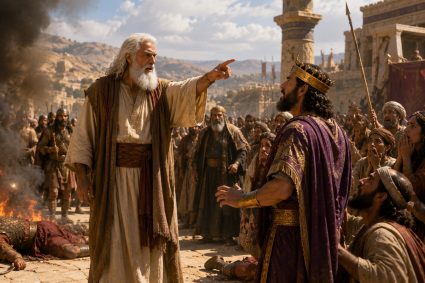
As he approached the city, Jehu the seer came out to meet him. He asked the king: “Should you help the wicked and love those who hate the Lord?” The words were severe, but just. Jehoshaphat had to recognize that his alliance with Ahab had not merely been a political mistake. It had been a spiritual failure.
Yet the correction also contained hope. Jehu reminded him that good had been found in Jehoshaphat. He had removed the Asherah poles from the land and had set his heart on seeking God. The Lord did not reject him, but called him to repentance.
Jehoshaphat accepted the correction. He did not harden his heart or persecute the prophet. Instead, he devoted the following years once more to the spiritual and social renewal of Judah. From Beersheba to the hill country of Ephraim, he traveled through the land and brought the people back to the God of their fathers.
An important part of his reform was the reorganization of the judicial system. Jehoshaphat appointed judges in the fortified cities of Judah. He reminded them that they did not judge on behalf of human beings, but on behalf of the Lord.
These judges were to remain aware that God Himself was with them when they rendered judgment. Therefore, they were not to show partiality or accept bribes. Wealth, position, personal relationships, or social influence were not to cause anyone to receive preferential treatment before the law.
Jehoshaphat also established a supreme court in Jerusalem. Levites, priests, and heads of families were to examine difficult cases and settle disputes. Spiritual and civil matters were each entrusted to responsible leaders.
The king urged all the judges to act in the fear of the Lord, faithfully, and with an undivided heart. They were not merely to condemn people, but also to instruct them concerning God’s law. In this way, further transgression was to be prevented and peace preserved in the land.
Jehoshaphat understood that true justice had to benefit the weak especially. The poor, the orphan, the needy, and the oppressed were not to be overlooked. A righteous kingdom was shown not only by strong walls, but by the way the defenseless were treated.
Thus Jehoshaphat sought to protect the rights and freedoms of his subjects. He knew that every human being was precious before God and that human judges stood under the authority of the supreme Judge.
Toward the end of his reign, Jehoshaphat’s faith was severely tested once more. A vast army of Moabites, Ammonites, and people from Mount Seir advanced against Judah. The news caused great fear because the enemy forces had already reached En Gedi.
Jehoshaphat was neither an inexperienced nor a weak ruler. For years, he had built up his army and fortified his cities. He possessed weapons, soldiers, and defensive structures. Yet in this hour, he did not place his trust first in human power.
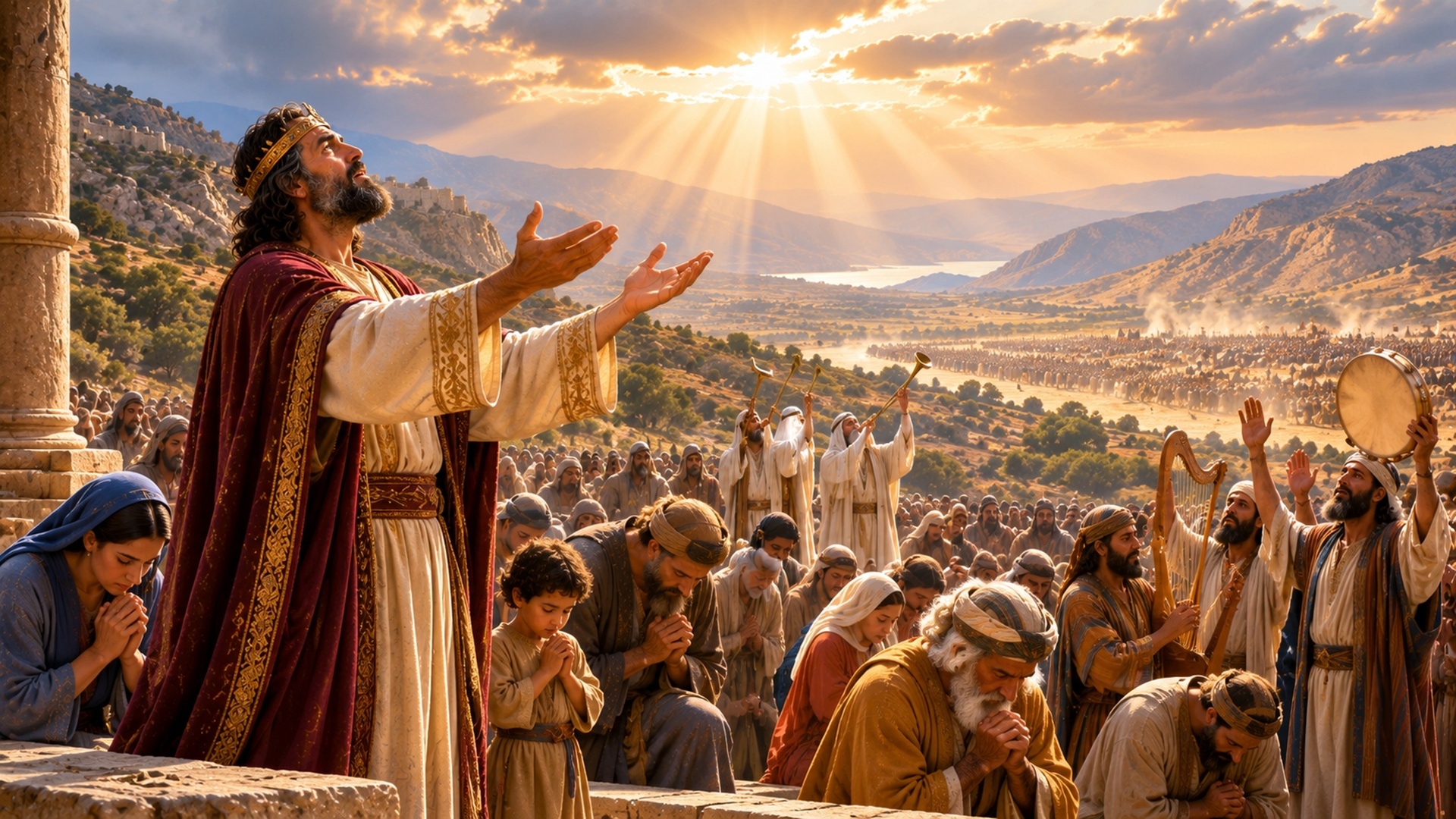
The king was afraid, but his fear did not drive him into panic. It drove him to prayer. He set his face to seek the Lord and proclaimed a fast throughout all Judah.
People came to Jerusalem from every city. Old and young, men, women, and children gathered before the Lord. The nation faced more than a political crisis. It recognized that its only hope was in God.
In the temple court, Jehoshaphat stood before the assembly. There he offered a prayer that revealed both his deep faith and his complete helplessness. He reminded God that He ruled over all the kingdoms of the nations and that no one could withstand His power.
Jehoshaphat looked back upon God’s guidance in history. The Lord had given the land to His people and had confirmed His promises to the descendants of Abraham. In Jerusalem stood the sanctuary that bore God’s name.
The king recalled the promise that in times of war, judgment, disease, or famine, the people could stand before this house and cry out to God. Now such an hour had come.
Jehoshaphat openly described the threat. The nations whom Israel had spared during the exodus from Egypt were now coming to drive Judah out of the inheritance God had given them. The king did not ask for victory because Judah was perfect or strong. He appealed to God’s justice and faithfulness to His covenant.
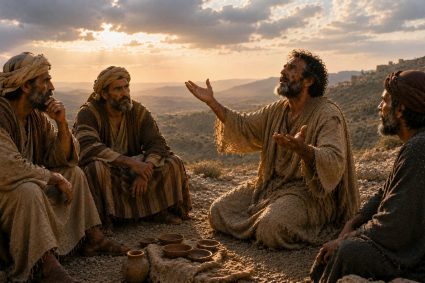
Then he made the open confession: “We have no power against this great multitude that is coming against us. We do not know what to do, but our eyes are upon You.” In these words lay Jehoshaphat’s true strength.
He did not deny his fear. Nor did he pretend to have a solution of his own. He confessed his helplessness and at the same time fixed his eyes on the Almighty God. The entire nation stood with him before the Lord.
While Judah was still praying, the Spirit of God came upon Jahaziel, a Levite from the sons of Asaph. He proclaimed a clear message to the king and the people: They were not to be afraid or discouraged, for the battle was not theirs, but God’s.
The following day, they were to go out against the enemy. Yet they would not have to fight in the usual way. They were to take their positions, stand still, and see the salvation of the Lord.
When Jehoshaphat heard this message, he bowed with his face to the ground. All Judah and the inhabitants of Jerusalem fell down before the Lord and worshiped Him. Even before the danger had disappeared, they responded with worship.
Then the Levites rose and praised the God of Israel with a loud voice. The victory was not yet visible, and the enemy army was still in the land, but the people had already begun to give thanks.
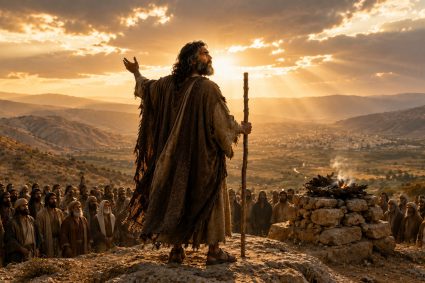
Early the next morning, Judah went out into the wilderness of Tekoa. Before they departed, Jehoshaphat addressed the people and said: “Believe in the Lord your God, and you shall be established; believe His prophets, and you shall prosper.”
After consulting with the people, the king appointed singers to go before the army. They wore holy garments and praised the Lord for His mercy and goodness.
It was an unusual order for a military campaign. The strongest soldiers did not go first, but the singers. The air was filled not with battle cries, but with praise. Through their song, the people declared that their trust rested not in sword and spear, but in God.
When they began to sing and praise, the Lord Himself intervened. Confusion arose among the enemy armies. The Ammonites and Moabites turned against the men from Mount Seir. After destroying them, they fought against one another until no one remained.
When Judah reached the lookout point in the wilderness and saw the great army, only the fallen remained. The battle that the people could not win in their own strength had already been decided.
For three days, Judah gathered the spoil because it was so abundant. On the fourth day, the people assembled in the Valley of Beracah, the Valley of Praise, and gave thanks to the Lord.
Afterward, they returned joyfully to Jerusalem. Psalteries, harps, and trumpets accompanied them to the house of God. The city that only a few days earlier had been filled with fear now echoed with praise to the Lord.
Judah had experienced that God’s resources are unlimited. From a human perspective, the situation had appeared hopeless, but the very greatness of the impossibility made God’s intervention even more visible.
News of this victory spread among the surrounding nations. They recognized that the Lord Himself had fought for Israel. The fear of God came upon the kingdoms, and Jehoshaphat’s realm once more enjoyed peace.
The life of Jehoshaphat reveals a man who sincerely sought God and yet was not free from mistakes. He carried out reforms, instructed the people, strengthened the administration of justice, and trusted the Lord in the greatest crisis. At the same time, his alliance with Ahab nearly brought him to ruin.
His story makes clear how dangerous false connections can be. Spiritual convictions must not be sacrificed for political convenience, social approval, or personal friendship. A person may love God and still be drawn through unwise relationships into situations where judgment becomes weakened.
Yet Jehoshaphat’s story also reveals the patience of God. The Lord corrected him, preserved him in battle, and gave him an opportunity to put his mistakes right. Jehoshaphat accepted the correction and once more devoted his strength to truth and justice.
Especially his prayer in the hour of danger remains an enduring testimony of faith. He confessed not only God’s power, but also his own helplessness. His eyes were fixed not on the greatness of the enemy, but on the One who rules over all kingdoms.
The victory did not begin on the battlefield, but in the temple. It began with fasting, prayer, humility, listening to God’s Word, and praising His promise. The people did not win because they were stronger, but because they relied completely upon the Lord.
Thus Jehoshaphat’s life reminds us that true leadership begins with the fear of God. A leader serves the people best when he knows God’s Word, protects justice and mercy, accepts correction, and seeks the Lord first in times of crisis.
The same principles remain valid today. Knowledge, power, organization, and preparation all have their place, but they must never take the place of God. In every humanly impossible situation, Jehoshaphat’s confession still applies: “We do not know what to do, but our eyes are upon You.”
⋯⋯⋯⋯⋯⋯⋯⋯⋯⋯◆⋯⋯⋯⋯⋯⋯⋯⋯⋯⋯
🧺 Summary
Jehoshaphat sought the God of his fathers and led Judah through spiritual reforms, thorough instruction, and a just system of law. Under his leadership, the nation experienced peace and prosperity. Yet his alliance with Ahab placed him in great danger and showed how serious the consequences of unwise relationships can be. After God corrected him, Jehoshaphat renewed his efforts for truth and justice. When a mighty army advanced against Judah, he placed his hope not in weapons and fortifications, but in God. Through fasting, prayer, faith, and praise, the people experienced a wonderful deliverance without having to fight themselves.
⋯⋯⋯⋯⋯⋯⋯⋯⋯⋯◆⋯⋯⋯⋯⋯⋯⋯⋯⋯⋯
🔦 Message for Us Today
Jehoshaphat’s story reminds us to make God’s Word the foundation of our decisions. Success, experience, and good preparation must not tempt us to act without God’s guidance. Wrong alliances can weaken our faith and lead us down paths we never intended to follow. At the same time, we may know that God accepts sincere repentance and can use us again after our mistakes. In situations where our strength is insufficient and we can see no way out, we should fix our eyes upon the Lord. The battle belongs to Him, and His intervention often begins where we confess our helplessness and thank Him in faith.
⋯⋯⋯⋯⋯⋯⋯⋯⋯⋯◆⋯⋯⋯⋯⋯⋯⋯⋯⋯⋯
📝 Reflection
Do I make my decisions first according to human reasoning, or do I seek God’s will? Are there relationships or influences in my life that weaken my spiritual clarity? Am I willing to acknowledge my own helplessness and fix my eyes completely upon God? Can I thank Him even before I see His solution?
“We do not know what to do, but our eyes are upon You.” (2 Chronicles 20:12)
