








🤩 Bible Stories to Marvel At
Where God’s miracles become great – for little and big children
🌩️ Job Chapter 20 – Zophar Responds with a Serious Warning
⚠️ When Zophar Warns Against False Happiness
🌅 Introduction
In the previous chapter, Job had spoken in a deeply moving way. He had told his friends how deeply their words hurt him. He felt abandoned by people, forgotten by relatives, and misunderstood by friends. His heart was full of pain, and yet, in the middle of his lament, a wonderful sentence shone forth.
Job said that he knew his Redeemer lives. It was like a ray of light in a dark night. Although Job was ill, although his friends were pressuring him, and although many questions remained unanswered, he held on to this hope. He believed that God knew the truth about him and that his suffering would not simply be forgotten.
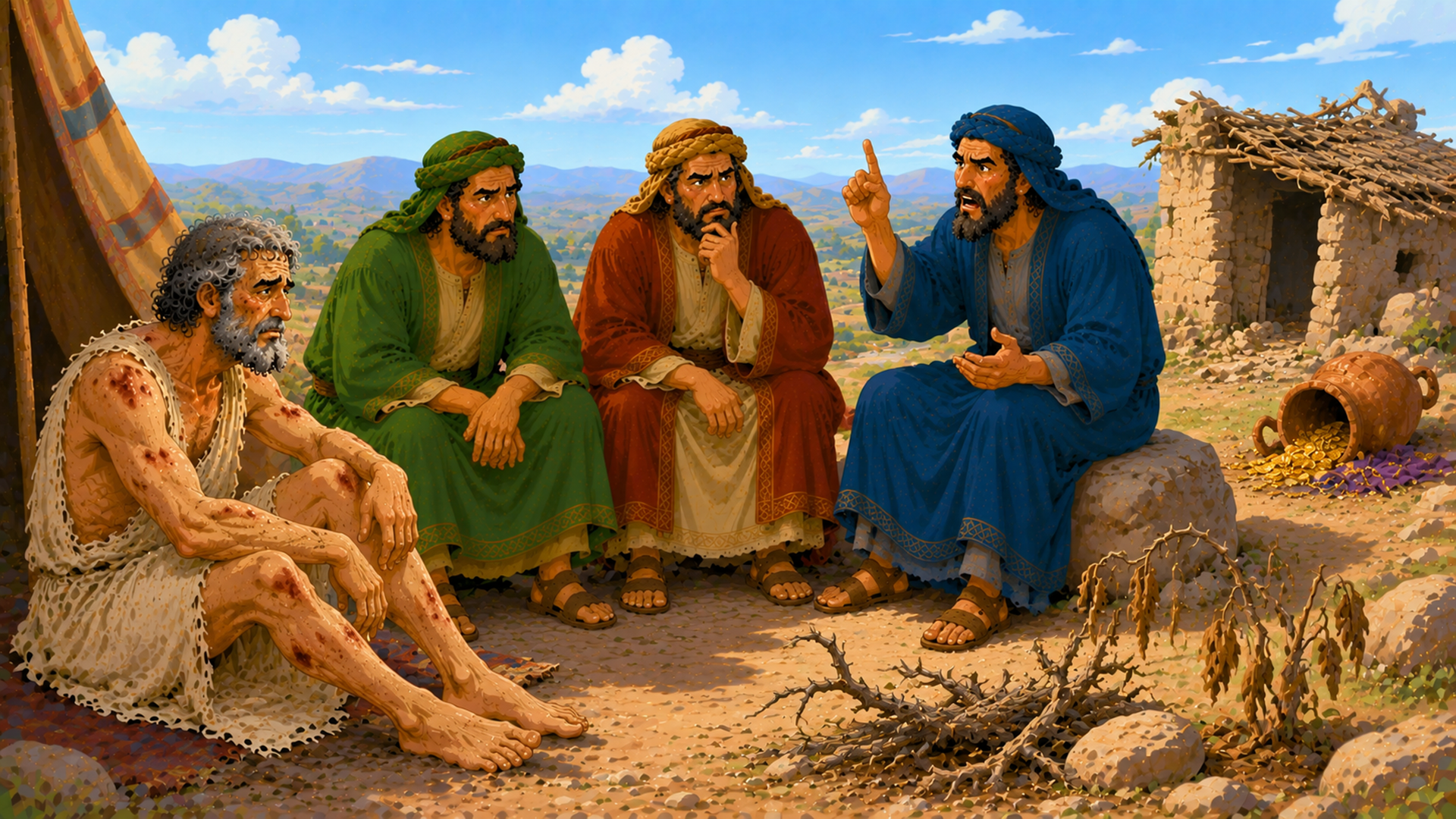
But his friends did not receive this statement of hope as one might have wished. They could have marveled. They could have asked what Job meant. Perhaps, for the first time, they could have become more cautious. But Zophar, the third friend, becomes restless.
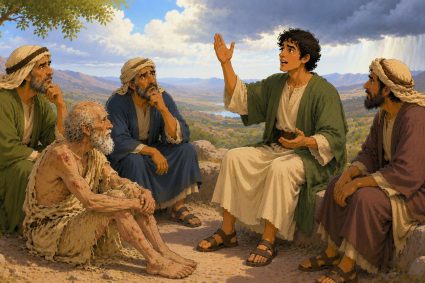
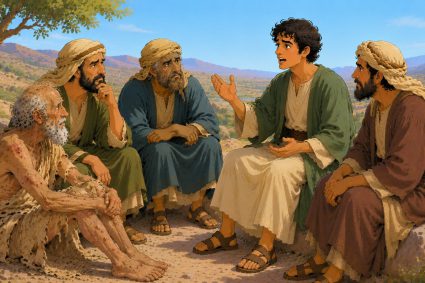
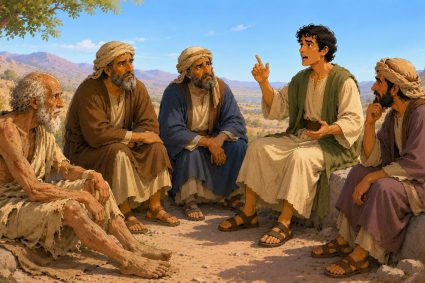
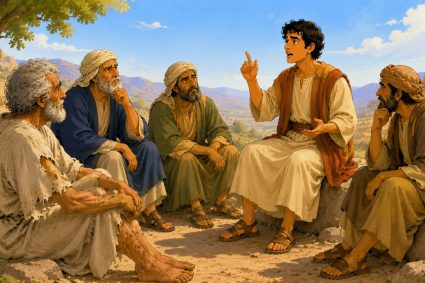
Zophar feels personally challenged by Job’s words. To him, Job’s answer does not sound like an honest lament, but like a provocation. He believes he must respond immediately and warn Job once again. So he answers with a speech that sounds serious and harsh.
This chapter tells how Zophar speaks about the short-lived happiness of the wicked. He describes people who rely on wealth, power, and injustice, but eventually lose everything. His warning contains serious thoughts. Yet because he directs it against Job, it once again fails to bring comfort. Job needs understanding, but Zophar adds another burden.
📖 The Biblical Story
😟 Zophar Becomes Troubled Within
Zophar begins his speech by saying that his thoughts are pressing him. He feels stirred up and cannot remain silent. Job’s words have irritated him. It is as though something inside him is saying: Now you must answer.
He believes he has heard a humiliating rebuke. Perhaps he thinks Job has attacked his friends too harshly. Perhaps he is annoyed because Job does not simply accept what they say. Zophar sees himself as being on the side of wisdom and wants to show Job that he is wrong.
But even here, we can see that Zophar does not first listen to Job’s pain. Above all, he listens to his own anger. He reacts quickly and sternly instead of becoming quiet and asking: What does Job truly need right now?
This still happens today. When someone speaks out of sadness or despair, others may feel attacked and answer immediately. But a quick word spoken in anger can wound an already hurting heart even more. Zophar speaks because he feels compelled to do so, but his words will not heal Job.
📜 Zophar Appeals to an Ancient Truth
Zophar says that people have known for a long time how things end for the wicked. He presents his message as a very old and certain truth: the happiness of evil people lasts only a short time.
He points out that a person may rise high for a while. He may appear proud, become rich, gain power, and be admired by others. It may even seem as though no one can harm him.
But Zophar says: this happiness does not last. It exists only for a moment. It may rise high, but it falls again. A person who sets himself against God cannot remain secure forever.
In itself, this warning is serious and important. A life built on injustice is not a safe path. But Zophar makes the same mistake as the other friends: he speaks as though Job must belong to exactly this kind of person. In this way, a general warning becomes a painful accusation.
☁️ As High as Heaven, Yet Still Temporary
Zophar describes the wicked person as someone whose pride rises to heaven. His head seems to touch the clouds. He appears great, untouchable, and strong.
Children might imagine it like a tower of building blocks that is made higher and higher. At first, everyone is amazed. The tower looks impressive. But if it stands on an unstable surface, one small push is enough, and everything collapses.
This is how Zophar understands false pride. A person may make himself seem very great. He may believe that he needs no one, least of all God. But if his life is not built on truth and justice, then his greatness has no firm foundation.
Zophar says that such a person suddenly disappears. Others then ask: Where has he gone? What looked so powerful did not remain. Proud splendor fades like something that cannot be held on to.
💨 Like a Dream That Disappears
Zophar uses another image: the wicked person disappears like a dream. During the night, a dream can seem very real. We see images, hear voices, and experience things as though they were truly happening. But in the morning, everything is gone.
This is how Zophar describes false happiness. It may shine for a short time, but it does not remain. People may look for it, but they can no longer find it. It is like a beautiful soap bubble that shimmers in the sunlight and suddenly bursts.
These images make Zophar’s speech vivid. He wants to show that a life without God has no secure future. Someone who builds on pride and injustice may experience brief success, but not lasting peace.
Yet for Job, this speech must once again have been painful. Job had not dreamed of false happiness. He had suffered real losses. His children had died, his possessions were gone, and his health had been ruined. When Zophar speaks about the disappearance of the wicked, it sounds as though he wants to explain Job’s losses by saying: This is simply the end of a bad person. And that was cruel.
🍯 Sweet in the Mouth, Bitter in the Stomach
Then Zophar describes evil with an especially powerful image. He says that evil can be sweet in a person’s mouth. At first, it tastes pleasant, like something one wants to keep and not let go.
But later it becomes bitter. What was sweet at first turns into poison. The person realizes too late that what he desired did not bring life, but harm.
Children might imagine it this way: someone finds a beautiful, colorful bottle and thinks it contains juice. It looks inviting. But in reality, it contains something dangerous. If someone drinks it, they become sick. Not everything that looks beautiful is good.
Zophar means that sin can appear attractive at first. Lying, stealing, cruelty, or pride may feel like an advantage for a moment. But in the end, they make the heart sick and destroy relationships.
💰 Wealth Gained Unjustly Does Not Last
Zophar continues by speaking about a person who swallows wealth but must give it back again. What he has taken through injustice does not remain with him. He cannot truly enjoy it.
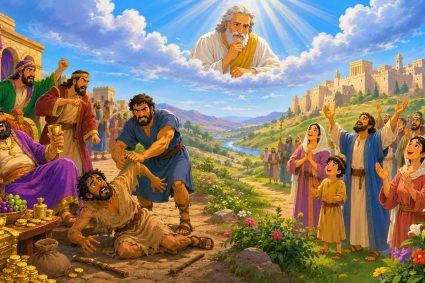
He describes someone who oppresses the poor, takes possession of houses, and greedily wants more than belongs to him. Such a person may think: Now I am secure. Now I am strong. Now nothing can happen to me.
But Zophar says that this injustice returns. Whoever takes from others what rightfully belongs to them builds his life on guilt. That cannot end well. God also sees what people would like to hide.
This message is important: God loves justice. He sees the poor and the weak. He does not overlook it when people exploit others. But once again, the problem is that Zophar directs this truth toward Job, even though Job is not sitting before him as an oppressor, but as a suffering man.
🍽️ Greed Finds No Rest
Zophar describes the wicked person as someone who never has enough. He is like a person who keeps eating but is never satisfied. He wants more possessions, more power, more security, and more honor.
But this greed gives no rest. Even if the person has many things, his heart remains empty. He fears losing something. He must hold on, defend, and keep chasing after more.
It is like a bag with a hole in it. More and more is placed inside, but nothing remains. That is what a heart is like when it always wants more without God. It never truly becomes full.
Zophar says that at the very moment when the wicked person thinks he has everything, distress comes upon him. His security collapses, and he realizes that his possessions cannot save him.
🏹 Zophar Paints a Picture of Judgment
Then Zophar’s words become even more serious. He describes disaster overtaking the wicked person. It is as though he cannot escape. He flees from one danger and falls into the next. Arrows, terror, and darkness appear in his images.
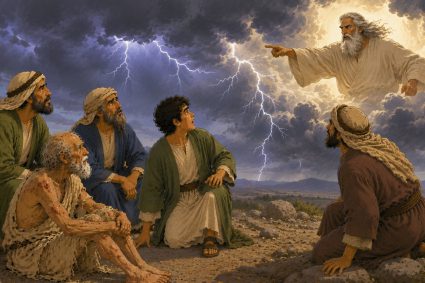
Zophar wants to show that no one can hide from God. If a person deliberately lives in evil, he cannot simply pretend that no one sees it. God is just, and in the end, what is hidden comes to light.
This is a serious truth. The Bible repeatedly says that God brings justice. Wrongdoing does not remain hidden forever. Someone who hurts others should not think that God does not see it.
But this speech does not fit Job. Job did not ask for wrongdoing to remain hidden. He asked for understanding. He cried out to God. He suffered under false suspicion. Therefore, Zophar’s message of judgment does not sound to Job like truth that brings healing, but like a false accusation.
🌊 Heaven and Earth Become Witnesses
Zophar says that heaven will reveal the guilt of the wicked and that the earth will rise up against him. This is a powerful image. It means that in the end, the truth will not remain hidden. Even if people try to conceal it, it will become visible.
The picture is striking: heaven above and earth below stand as witnesses. Everything that was hidden comes to light. No one can hide injustice under a rug forever.
Here too, we hear something about God’s justice. God sees more deeply than people do. He knows deeds, thoughts, and paths. Therefore, no one can deceive God.
But for Job, this is painful again. He himself longs for the truth to come to light. In the previous chapter, he wanted his words to be written down. He longs for a Redeemer who will stand up for him. Zophar speaks of exposure, but he does not understand that Job is not the one hiding something; he is the one who has been misunderstood.
🏚️ Everything False Will Be Swept Away
Zophar says that the possessions of the wicked will be carried away. Everything he has gathered will not remain. His house, his security, and his treasures cannot save him from God’s judgment.
This is a serious reminder that material things are not the most important. Money, houses, clothes, and honor cannot give a person what only God can give. Someone who attaches his heart to these things builds on something that can break.
But Job already knew this. He had lost his possessions and still had not simply cursed God. He had learned that wealth cannot preserve life. Zophar speaks to him as though he still had to learn this lesson, but Job is already sitting in the middle of a loss that Zophar does not understand.
That is why Zophar’s speech sounds so harsh at the end. It contains warnings about false wealth and evil ways. But it does not answer Job’s real question. Job asks: Why does an upright person suffer? Zophar answers: The wicked lose everything. That is not an answer for Job’s heart.
🌟 A Serious Speech, but No Comfort
At the end, Zophar says that this is the portion God gives to the wicked person. With this, he summarizes his entire speech. For him, it is clear: the one who is evil loses his brief happiness, his security, his possessions, and his future.
But Zophar does not see how deeply his words hurt Job. He speaks about God, but he does not listen to Job. He defends a simple order, but he overlooks a suffering person who is searching for truth.
For this reason, this chapter does not only give us a warning against false happiness. It also gives us a warning against speaking wrongly. Even serious truths can hurt people when we apply them without love and understanding.
Job’s story continues. Zophar has spoken, but Job will answer. And his answer will show that the world is not always as simple as his friends think.
🌅 What This Chapter Shows
This chapter shows that Zophar describes the happiness of the wicked as brief and fragile. He speaks of pride that rises high and falls again, of false sweetness that becomes bitter, of unjust wealth that does not last, and of guilt that comes to light.
This chapter also shows that correct warnings directed at the wrong person can cause great harm. Zophar speaks about real dangers of evil, but he directs his speech against Job, who does not need more hopelessness through warnings, but understanding and mercy.
🟣 Summary
Zophar answers Job for the second time and speaks with great agitation. He says that the happiness of the wicked lasts only a short time, even if they first appear proud and powerful. Zophar describes evil as something that is sweet in the mouth but later becomes bitter and poisonous. He warns against unjust wealth, greed, false security, and God’s judgment. But Zophar makes the same mistake as the other friends: he applies these warnings to Job. As a result, he does not comfort Job, but accuses him once again.
💚 Message for Children Today
Not everything that looks beautiful or easy at first is truly good. Lies, cruelty, pride, or greed may feel like an advantage for a short time, but in the end they make the heart heavy and hurt others.
We also learn this: when someone is suffering, we should be careful about the words we say. A warning may be correct, but if it comes at the wrong time or is directed at the wrong person, it can hurt. That is why sad people first need compassion and a heart that listens.
💭 Questions for Reflection
🔸 Why does Zophar say that false happiness lasts only a short time?
🔸 What does the image “sweet in the mouth, but bitter in the stomach” mean?
🔸 Why did Zophar’s speech not really help Job?
🧒 👧 👦
💌 Invitation to Job Chapter 21
🧐 Job Looks Closely at Reality
Zophar has given a stern warning and said that the happiness of the wicked lasts only a short time. To him, everything seems simple: whoever lives wickedly will soon fall.
But now Job will answer and show that reality often looks more complicated. He observes that some wicked people live long lives, become rich, and apparently die without fear.
How does this fit with the simple explanations of his friends?
Come along and discover the next chapter!
🔔 Preview of Job Chapter 21
🔍 When the World Is Not So Simple
Job asks his friends to truly listen to him. Then he raises a difficult question: Why do some wicked people prosper even though they do not seek God?
👉 Why does Job disagree with Zophar’s simple explanation?
👉 What does Job observe in the lives of some people?
👉 And why does this chapter show that God’s ways are deeper than quick answers?
✨ In the next chapter, we will hear Job’s careful observations and learn that suffering and happiness are not always easy to explain.
