


















🤩 Bible Stories to Marvel At
Where God’s miracles become great – for little and big children
🧭 Job Chapter 27 – Job Holds Fast to His Integrity
⚖️ When Truth Is More Precious Than Comfort
🌅 Introduction
In the previous chapter, Job had spoken about God’s mighty power. He had shown that God supports the earth, holds the clouds, sets boundaries for the sea, and rules over the mysterious depths. Job knew very well that God is great. His friends did not need to explain that to him.
But precisely because God is so great, Job did not want to be satisfied with simple answers. His friends had repeatedly tried to explain his suffering. They said or thought: If Job is suffering so much, then he must be guilty. But Job knew that this explanation was wrong.
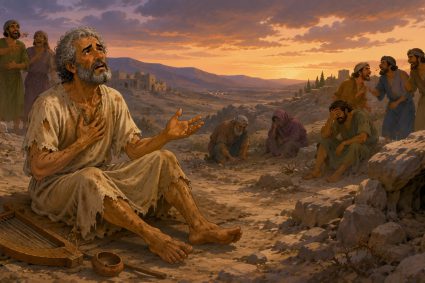
Now Job continues speaking. His words sound firm and serious. He is tired, sick, and wounded, but he does not want to let go of his integrity. He does not want to lie. He does not want to say, “Yes, you are right, I am guilty,” simply so that his friends will finally stop talking.
This is a difficult moment. Sometimes it would be easier to say something false just to bring an argument to an end. But Job knows that truth is more important than quick peace. He wants to remain honest before God, even when people misunderstand him.
This chapter tells how Job holds fast to his innocence and at the same time speaks about the end of the wicked. Job knows that a life without God has no secure hope. But he refuses to present himself as wicked when that is not true. His heart remains wounded, but his voice remains sincere.
📖 The Biblical Story
🗣️ Job Continues Speaking with a Serious Voice
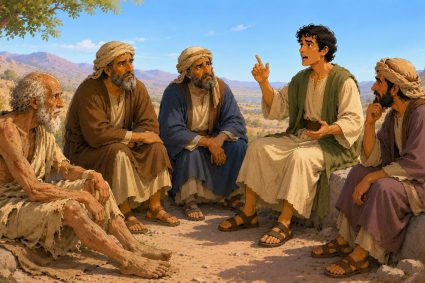
Job began to speak again. It was not merely a short answer. It was like a solemn speech in which a person says: Listen carefully, because what I am about to say comes from the deepest part of my heart.
Job was not calm because everything had become well again. His pain was still there. His friends still did not understand him. His questions to God had not yet been answered. Nevertheless, he spoke with a special firmness.
He knew that when people falsely accused him, he must not simply agree with them. When others told his story incorrectly, he must not give up the truth. His friends wanted him to admit guilt that they suspected in him. But Job could not do that.
A great deal was at stake for Job. It was not merely about being right in a conversation. It was about his honesty before God. And honesty before God was more precious to Job than the approval of his friends.
⚖️ Job Feels That God Has Not Treated Him Justly
Job speaks very honestly about God. He says that God has denied him justice and that the Almighty has made his soul bitter. These are difficult words. Job feels that God does not understand him and has not treated him fairly.
This does not mean that Job has abandoned God. He is speaking before God and about God. He is wrestling with Him. But he honestly says what it feels like to him: as though God’s hand were resting heavily on his life.
Sometimes people are afraid to tell God about their difficult feelings. They think they must always speak only beautiful and peaceful words. But Job shows that a suffering heart may also lament honestly. God is not too small for our difficult questions.
Job does not understand God’s way. But he does not pretend that his pain is small. He brings it into the light. This very honesty makes his story so profound.
🌬️ As Long as There Is Breath in Him
Then Job says something very important. As long as his breath is in him and God’s breath remains in his nostrils, he will not speak a lie. He knows that every breath comes from God. And as long as he lives, he does not want to betray the truth.
This is a powerful image. Job has little strength, but he still has breath. And with that breath, he does not want to lie. His lips must not speak what is wrong, and his tongue must not utter deceit.
For children, it can be imagined like this: If everyone in a class tells you to admit something you did not do, it might be easier simply to say “yes” so that they leave you alone. But deep in your heart, you know that it would not be true.
Job is standing at exactly such a difficult point. His friends are pressuring him with their words. But Job says: I will not lie. I will not confess false guilt.
🧱 Job Does Not Give Up His Integrity
Job clearly tells his friends that he cannot agree with them. Until the day of his death, he will not let go of his innocence. He holds fast to his righteousness and refuses to give it up.
This sounds very strong. Job does not mean that he is perfect like God. He knows that he is human. But he is saying: The accusation of my friends is not true. I am not the wicked man you make me out to be.
His heart must not condemn him as long as he lives. This means that Job does not want to act against his conscience. He wants to remain inwardly sincere.
This attitude is courageous. Job loses many things, but he does not want to lose the truth as well. His health is broken, his possessions are gone, and his friends have become harsh. Yet he holds on to his integrity like a final treasure.
🕯️ Truth Is Not Always Comfortable
Perhaps Job could have made things easier for himself. He could have said, “All right, you are right. I am guilty.” Then his friends might have thought they had won. The argument might have become quieter.
But that would not have been true peace. It would have been peace built on a lie. And peace built on a lie cannot heal the heart.
Job shows that truth is sometimes difficult. It can make us feel alone. It can mean that others do not understand us immediately. But truth is precious because it stands firm before God.
This is an important lesson for young and older readers alike. We should not stubbornly and proudly cling to a mistake. But when something truly is not right, we should not lie merely to please others.
🌑 Job Speaks About the Wicked
Then Job speaks about the person who lives without God. He says that such a person has no real hope in the end when God takes away his life. He may appear strong for a time, but his security has no deep foundation.
Job knows that his friends have spoken much about the end of the wicked. But now he shows: I also know that a life without God is not secure. I am not defending wickedness. I am only saying that I am not the person you claim I am.
This is an important difference. Job is not arguing against God’s justice. He is arguing against the false application of that justice to his own suffering.
He knows that whoever does not seek God has no firm refuge when everything else falls away. Wealth, power, and honor cannot save a person when the soul remains empty.
🙏 Will the Wicked Call on God?
Job asks whether a wicked person will call on God when trouble comes. Will he delight in the Almighty? Will he call on God at all times?
These questions show what is important to Job. For him, faith is not merely a word. It is about whether a person truly seeks God, cries out to Him, and finds joy in Him.
Job himself calls out to God again and again. Sometimes he laments. Sometimes he asks questions. Sometimes he understands nothing. But he remains in conversation with God. This is exactly what shows that Job is not simply a wicked man.
A wicked person often does not want to know God. But Job wants to find Him. He wants to stand before Him. He wants to be heard. Therefore, the accusations of his friends do not fit his heart.
📜 Job Wants to Teach About the Hand of God
Job says that he wants to teach his friends about the hand of God. This is surprising. His friends had thought that they needed to teach Job. But Job shows that he too takes God’s ways seriously.
He does not want to hide what belongs to the Almighty. He wants to show that God’s judgment upon evil is real. But at the same time, he wants his friends not to judge superficially.
In effect, Job says to them: You yourselves have seen many things. Why then do you speak so emptily? Why do you use truths about God in a way that does not help?
Here we can feel both Job’s pain and his clarity. He is wounded, but he thinks deeply. He refuses to be forced into a false role. He remains a man who reflects on God and seeks truth.
💰 Wealth Without God Gives No Security
Job now describes how the wicked person may have many children, possessions, and riches. But none of this gives him final security. What he gathers may pass to others. What he builds may collapse.
For children, one can imagine a large treasure chest. Someone keeps putting more and more into it and thinks: Now I am safe. But if the chest has no solid bottom, everything will eventually fall out.
Job wants to show that possessions are not evil, but possessions without God cannot save the heart. Whoever trusts only in things builds on something that does not last forever.
Job himself knows this very well. He once had possessions and lost them. Therefore, he knows that a person’s greatest treasure must not lie in things that can disappear.
🏚️ A House Like a Fragile Web
Job speaks about the house of the wicked. It may appear strong and secure. But in reality it is fragile like a spider’s web or like a shelter that a watchman builds only for a short time.
A spider’s web may look beautifully designed. When the sun shines on it, it may even sparkle wonderfully. But it is thin and easily destroyed. That is what false security without God is like.
A person may display a beautiful life outwardly and still have no firm support within. He may own a house and yet have no peace. He may be rich and still poor in hope.
Job recognizes that only God gives lasting security. Everything else can quickly tear apart.
🌪️ The End Comes Like a Storm
Job describes how the wicked person lies down rich, but suddenly everything changes. Terrors may seize him like floodwaters. A storm may carry him away in the night.
These images are strong and frightening. They show that false security can suddenly collapse. A person may think that everything is firm, but then something comes that he cannot control.
The east wind carries him away, Job says. The storm tears him from his place. Such is a life without a firm foundation: it cannot stand when the great winds come.
By this Job does not mean that every storm in life is a sign of guilt. His own story has already proved the opposite. Rather, he is saying that whoever truly lives wickedly and does not turn to God will have no secure support in the end.
🏹 No One Can Escape God’s Judgment
Job continues by saying that God will not spare the wicked when judgment comes. The person will want to flee, but he cannot escape from God’s hand.
This is a serious truth. People can run away from other people. They can hide, make excuses, or pretend that nothing happened. But no one can hide the truth from God.
For children, one can say: When we have done something wrong, it is better to be honest and ask forgiveness than to keep running away. God sees the truth, but He is also willing to listen to an honest heart.
Job knows that God’s judgment is real. Therefore, his defense is not an excuse for evil. He simply does not want to be condemned for something he has not done.
👏 In the End, False Honor Does Not Remain
Job says that people will clap their hands at the wicked and hiss him out of his place. This means that his false honor disappears. People no longer admire him, but recognize his end.
A life built on pride, injustice, and wickedness may shine for a time. But that shine does not last. In the end, it becomes clear that it had no true foundation.
In this way, Job says to his friends: I know that evil does not win. I know that God is just. But I am not the person you are making me out to be.
This is the heart of the chapter. Job holds two truths together: He defends God’s justice against evil, and he defends his own integrity against false accusations.
🌟 Job Remains Upright in His Pain
At the end of this chapter, Job is still suffering. His situation has not become easier. His friends have not yet recognized their mistake. God’s answer has not yet come.
But Job remains upright in his soul. His body is weak, yet his conscience holds firm. He does not want to lie. He does not want to abandon God. He does not want to give up the truth.
This is what makes the chapter so powerful. Job shows that integrity is not important only when everything is easy. Precisely when people misunderstand us, it becomes clear whether we hold fast to the truth.
Job reminds us: An honest heart before God is more precious than easy peace with people. Truth can be difficult, but it supports us more deeply than any lie.
🌅 What This Chapter Shows
This chapter shows that Job does not give up his integrity. He refuses to confess false guilt merely so that his friends can be right or the argument can end. As long as there is breath in him, he does not want to speak a lie.
This chapter also shows that Job does not deny God’s justice. He knows that a wicked life has no secure future. But he makes it clear that this truth must not be falsely used against him.
🟣 Summary
In chapter 27, Job speaks with great determination. He feels that God has treated him harshly, but he still refuses to speak a lie. As long as there is breath in him, he holds fast to his integrity and does not surrender his innocence. Job says that a wicked person has no real hope when God takes away his life and that wealth without God gives no lasting security. He describes how false security collapses and how no one can escape God’s judgment. At the same time, Job makes it clear that he is not defending evil, but his own truth against false accusations.
💚 Message for Children Today
Job shows us that honesty is very precious. We should not lie or admit something false merely to make others satisfied. Before God, truth is more important than quick and comfortable peace.
We also learn that God sees our hearts. Even when people misunderstand us, we may still remain honest. And when we truly have done something wrong, we should not run away, but come to God and ask for forgiveness.
💭 Thought for Reflection
🔸 Why did Job refuse to confess false guilt?
🔸 What does it mean to hold fast to integrity?
🔸 Why does wealth without God give no real security?
🧒 👧 👦
💌 Invitation to Job Chapter 28
💎 Job Searches for True Wisdom
Job has held fast to his integrity. He did not want to lie or pretend that he was guilty merely to satisfy his friends. For him, truth remained more precious than comfort.
Now Job will speak about something very profound: wisdom. People can find silver, mine gold, and bring precious stones out of the earth. But where can true wisdom be found?
Is wisdom hidden somewhere like a treasure?
Come along and discover the next chapter!
🔔 Teaser for Job Chapter 28
🔦 When Wisdom Lies Deeper Than Gold
People search deep within the earth for treasures. They find silver, gold, and precious stones. But Job asks: Where does wisdom dwell?
👉 Why is wisdom more precious than gold and pearls?
👉 Why can human beings not simply dig it out of the ground?
👉 And what does God say about where true wisdom begins?
✨ In the next chapter, we will hear one of the most beautiful songs of wisdom in the book of Job and discover that true wisdom begins with reverence for God.