








👑 From Babylon to the Eternal Kingdom
📜 Historical, Spiritual, and Prophetic Poems from the Book of Daniel
🌟 Chapter 1 – Miniseries 3
📖 Wisdom from Above
✨ When God Blesses the Faithful with Understanding
🏛️ Poem 6 – Serving at the Court of Babylon
👑 When God Led His Servants to the Place of Their Calling
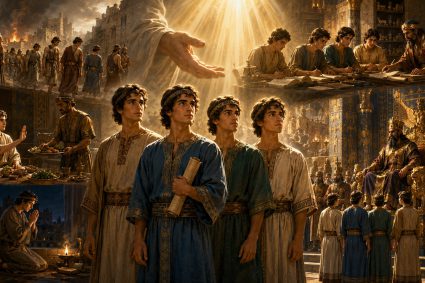
The test had now been fully passed,
and God’s great power was revealed.
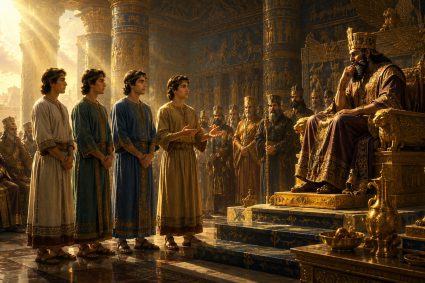
The king himself had recognized
what God’s own hand had placed within them.
Daniel and his faithful friends
now stood prepared to serve the kingdom.
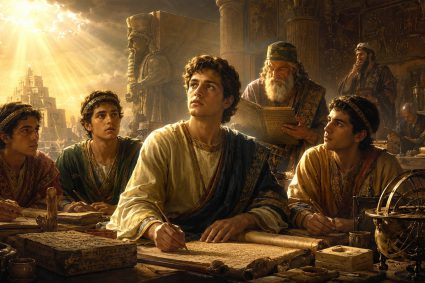
The years of training were complete,
and new responsibilities awaited them.
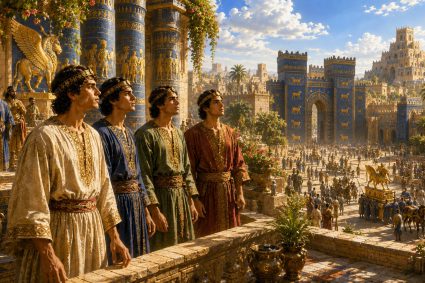
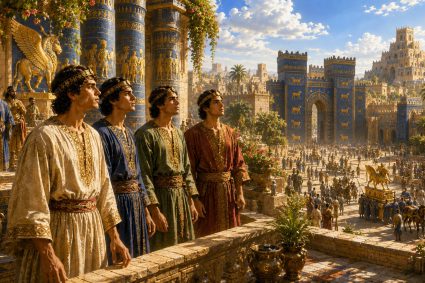
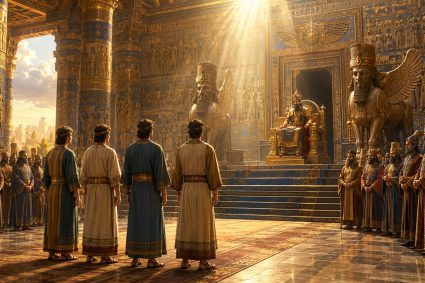
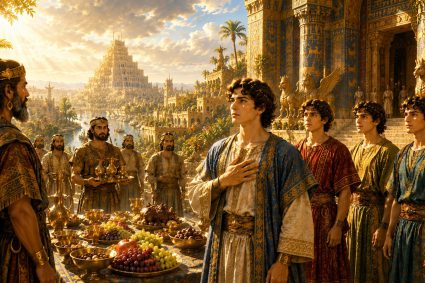
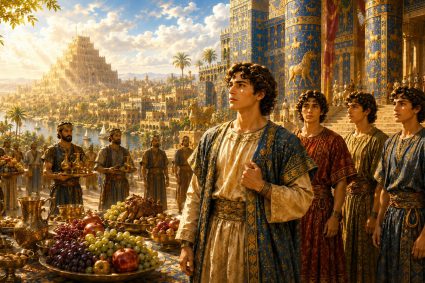
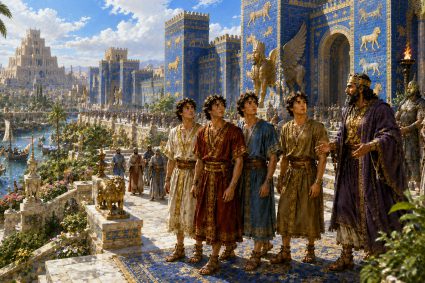
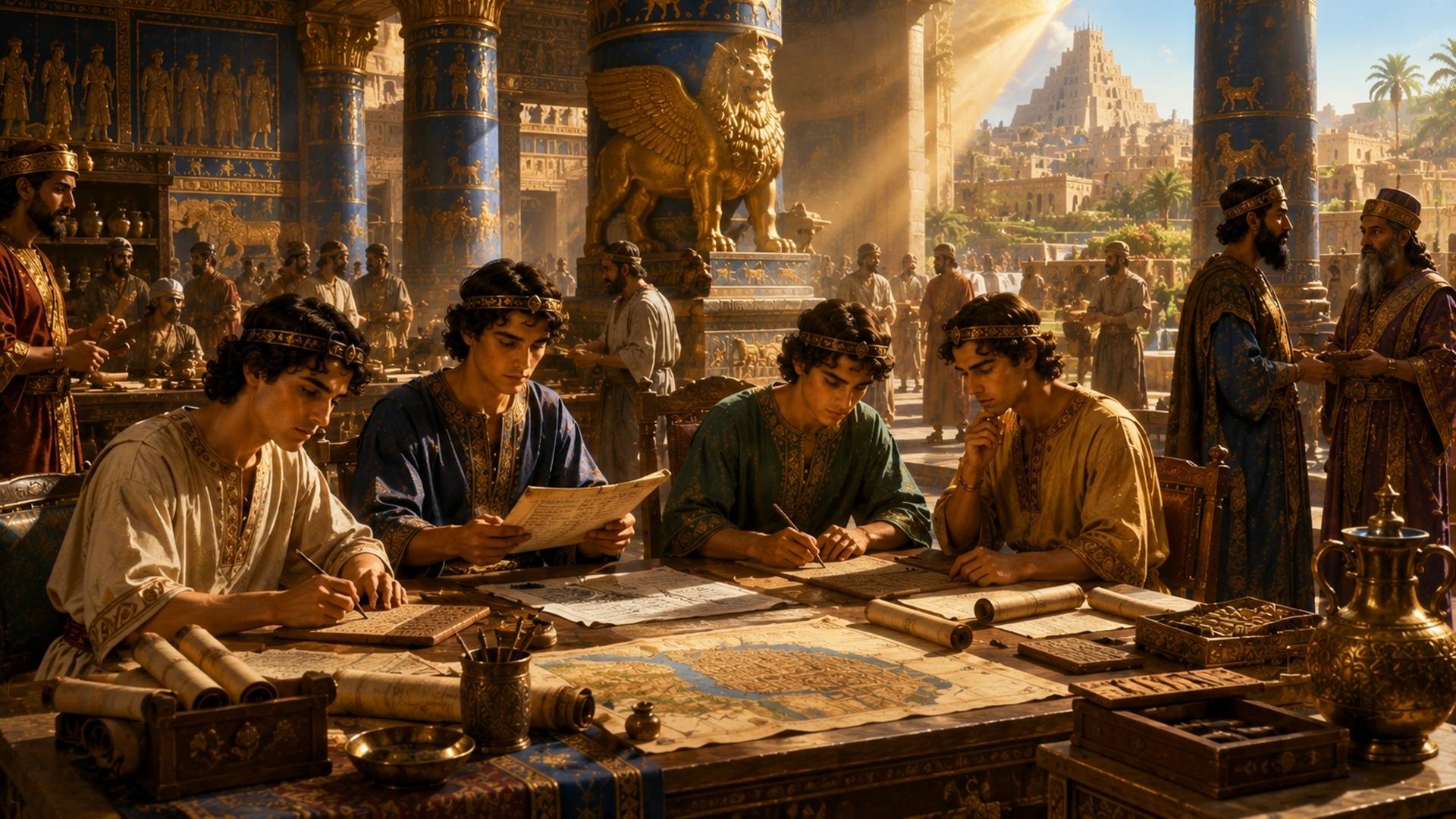
The halls of Babylon were vast,
filled with splendor, fame, and grandeur.
The princes entered and departed
through the mighty royal house.
There matters of great weight were weighed,
shaping the destiny of nations.
There they spoke of war and peace,
of distant lands and neighboring kingdoms.
Now men from Judah stood among them,
far away from their native land.
Once they had been called captives;
now they were known throughout the kingdom.
This had not come through force or striving,
nor through ambition or human effort.
The Lord had led them step by step
and safely guided all their ways.
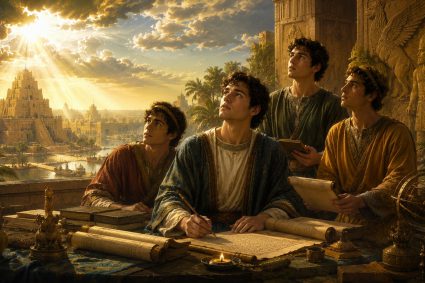
Daniel often thought again
of Jerusalem’s former joy,
of Zion and the temple hill,
of God’s own people and their calling.
Yet sorrow no longer ruled his heart,
for God’s direction mattered more.
The Lord had given him a place
to live within foreign Babylon.
Hananiah stood faithfully beside him,
filled with faith and steadfastness.
Mishael and Azariah likewise
were witnesses for God within the realm.
The world saw servants of a king,
but heaven saw far more than this.
It saw four men filled with light
who had not abandoned their faith.
Service at court was more than honor;
it carried solemn responsibility.
For those who stand near to a king
must be faithful in their deeds and counsel.
Day by day they carefully fulfilled
the duties that had been entrusted.
They worked with quiet clarity,
for reverence for God inspired them.
The people valued their advice
because their words were filled with wisdom.
Yet Daniel always understood
to whom all honor truly belonged.
Babylon had not given him understanding,
nor human strength or human hands.
The Most High had guided him
and ordered every path before him.
Thus the palace became a place
where God’s own living Word
through life, conduct, and behavior
could speak before the eyes of many.
Some noticed their diligence,
and others saw their lucid minds.
Yet few already understood
that God Himself was working behind it all.
The Lord had not preserved them
merely to keep them safe and comfortable.
He placed them in that very place
as bearers of His treasury of truth.
For soon the realm of Babylon
would once again be deeply shaken.
Hidden mysteries would be revealed
through the wondrous power of God.
Heaven was preparing everything
long before a doorway opened.
And Daniel already stood prepared
for the task and season yet to come.
Thus this ancient Scripture shows us
how God’s own plan encounters lives.
He often leads His people to the place
where they are needed in His will.
Not every road is easy to walk,
nor can all things be understood at once.
But those who dedicate their lives to God
are guided with unfailing faithfulness.
Daniel was still young in years,
yet rich in heavenly experience.
The Lord had strengthened his faith
and shaped him for far greater things.
His service began in quiet faithfulness,
day after day and ever anew.
No one in the land yet understood
what God intended to accomplish through him.
Yet one truth had already become clear:
the Most High reigns even in Babylon.
He guides the pathways of His servants
and leads them safely through the night.
Thus the third part came to an end,
yet God’s great plan continued onward.
Their preparation had not been in vain;
it served a higher, greater purpose.
For high above all kings and kingdoms,
above all power and earthly glory,
stands the eternal throne of God alone,
and all must finally submit to His will.
Thus Daniel’s example continues shining
through every age and every place.
Whoever trusts in God with heart and mind,
the Lord will lead toward His appointed calling.
🌟 Prophetic Reflection
🏛️ Daniel and his friends now served at the court of the most powerful empire of their age. From a human perspective, they were captives in a foreign land. Yet in God’s sight, they were not insignificant exiles, but chosen witnesses in a strategically important place. Babylon was the political, cultural, and intellectual center of a world empire. It was precisely there that God placed young men who would remain faithful to Him and reveal His character.
👑 God did not immediately remove Daniel and his friends from Babylon. He preserved them in the midst of Babylon. He did not lead them back to the familiar safety of Jerusalem, but allowed them to live, learn, and serve at the court of a pagan king. Their story demonstrates that God’s presence is not confined to a particular place. Even far from their homeland, the temple, and all that was familiar, Daniel could live in close fellowship with the Lord.
🙏 Faithfulness therefore does not always mean that God immediately brings difficult circumstances to an end. Sometimes He first changes not the surroundings, but the person living within them. Daniel had to learn to remain steadfast under pressure without becoming bitter. He served conscientiously without conforming to the spirit of Babylon. He treated those in authority with respect without surrendering his convictions. His faithfulness was neither loud nor combative, but quiet, clear, and constant.
🌱 It was precisely within this tension that God shaped his character. The court of Babylon became a school of faith. There Daniel learned to distinguish between accommodation and faithfulness. He discovered that one may serve a secular government without belonging to it spiritually. He fulfilled his responsibilities with care, yet his heart remained consecrated to the God of Israel. This inner freedom later enabled him to speak truth even to kings.
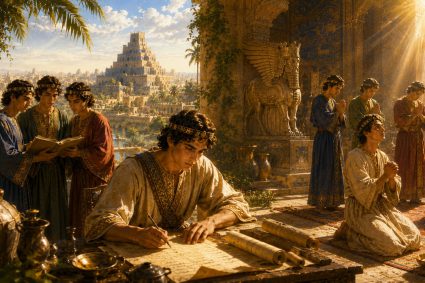
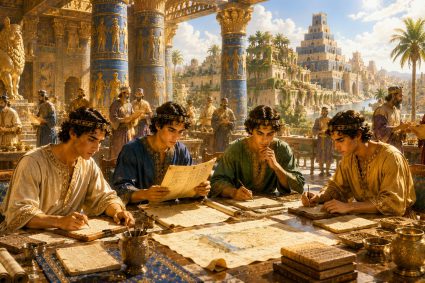
✨ The Lord prepared His servants through experience, testing, and increasing responsibility for greater tasks. The decision concerning the king’s food, their intensive study, the examination before the king, and their daily service at court were not isolated events. Together they formed a path of divine education. Every test faithfully endured laid the foundation for the responsibility that followed.
📖 What at first appears in Chapter 1 to be merely the story of four faithful young men becomes in the following chapters the setting for the revelation of divine truth. Daniel would interpret dreams, explain hidden mysteries, warn kings, and receive prophetic visions extending to the time of the end. Yet before God entrusted him with great revelations, He tested his faithfulness in the small matters of everyday life.
🔥 This reveals an important spiritual principle: God grants greater responsibilities not merely because of talent, but because of proven faithfulness. Daniel possessed extraordinary abilities, yet the decisive factor was his relationship with God. Knowledge alone could never have made him a prophet. Humility, prayer, obedience, and spiritual steadfastness made him a trustworthy instrument of heaven.
🌍 God still places His children in surroundings that challenge their faith. He sends them into workplaces, schools, families, institutions, and societies where His values are not taken for granted. There they are not to distinguish themselves through superiority, but through reliability, wisdom, purity, and love. Their lives may become a quiet witness long before they have an opportunity to speak openly about their faith.
🕊️ God’s people are not called to withdraw from every difficult environment. They are to learn how to live in the world without receiving the spirit of the world. Like Daniel, believers may accept responsibility, work with excellence, and serve those around them. At the same time, their highest loyalty remains with God. Whenever human demands contradict His Word, faithfulness to heaven must take precedence.
👑 From a Seventh-day Adventist perspective, Daniel’s service at the Babylonian court carries special prophetic significance. In Scripture, Babylon represents not only a historical world empire, but later also religious confusion, human self-exaltation, and false worship. Daniel’s life demonstrates how God’s people can remain faithful even in the midst of such systems. They do not absorb the spirit of Babylon, but bring the light of heaven into it.
📯 For this very reason, Daniel’s prophetic message does not begin in complete isolation, but at the center of worldly power. God reveals His purposes in the very place where human beings imagine that they control history. Kings believe they can establish empires and determine the course of time. Yet Daniel would show them that only the Most High knows and governs the rise and fall of nations.
⚖️ No ruler sits upon a throne beyond the reach of God. Political power may appear immense, yet it remains limited and borrowed. The Lord changes times and seasons; He removes kings and establishes kings. He gives wisdom to the wise and knowledge to those who possess understanding. Daniel’s presence at court was therefore no accident, but part of a far greater divine plan.
🤲 In the same way, the place where a person lives and serves today is not without meaning. A task may appear small, an environment foreign, or a responsibility burdensome. Yet God can prepare, shape, and use us precisely there. We do not always understand immediately why He has placed us in a particular situation. Often its significance becomes clear only later.
🌾 At the beginning, Daniel did not know what role he would play in history. He did not know every trial that lay ahead or every revelation he would receive. He knew only that he must remain faithful to God today. That daily faithfulness opened the way for a ministry whose influence would reach far beyond his own lifetime.
💡 This also encourages God’s people today. We do not need to know the entire plan in order to take the next step of obedience. God does not require us to understand in advance what greater tasks may come later. He calls us to be faithful where we stand now. From small and hidden decisions, He can bring forth a ministry that reaches many lives.
🙌 The Most High places His witnesses exactly where they are needed for His purpose. Some He calls to visible responsibilities, others to quiet service. Some speak before many people, while others influence only a few. Yet no faithful service is insignificant when God uses it. Its value does not lie in the size of the platform, but in faithfulness to the calling.
✨ Daniel and his friends were not swallowed up by Babylon. Through the grace of God, they became lights in the midst of Babylon. They proved that outward circumstances need not determine to whom a person inwardly belongs. Their story calls us to remain steadfast, humble, and willing to serve even in difficult times.
“And He changeth the times and the seasons: He removeth kings, and setteth up kings: He giveth wisdom unto the wise, and knowledge to them that know understanding.” (Daniel 2:21)
