












🌙 Still Awake?
Every evening, one step closer to Jesus.
📅 August 26
👣 Jesus Comes to the Jordan
📖 Matthew 3:13
“Then Jesus came from Galilee to John at the Jordan to be baptized by him.”
Matthew 3:13
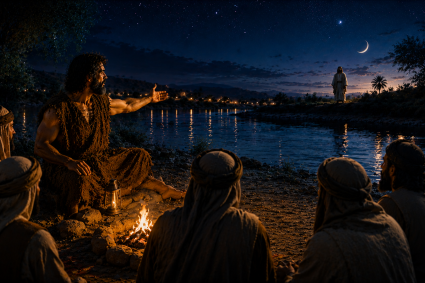
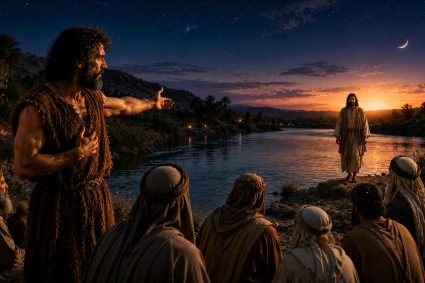
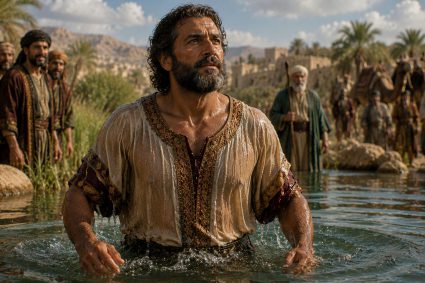
By now, many people had come to John at the Jordan. They had heard his message of repentance, confessed their sins, and been baptized. Again and again, John had made it clear that he himself was not the center of this movement. He was preparing the way for the Messiah, who would come after him and was infinitely greater than he was. Now the event toward which his entire ministry had pointed was taking place: Jesus left Galilee and came to the Jordan.
Matthew describes this significant moment in remarkably few words. Yet Jesus’ journey to the Jordan marked the beginning of an entirely new chapter. For many years, he had lived and worked in Nazareth and shared in the ordinary daily life of a family. Only a few people knew who he truly was. Now the time had come for Jesus to step out of this hidden life and begin his public ministry. Before him lay the proclamation of the kingdom of God, encounters with countless people, healings, opposition, rejection, and finally the road to the cross. Yet the first visible step into this new chapter did not lead him onto a grand stage, but to John at the Jordan.
🏡 The Quiet Years Were Not Wasted Years
The Gospels tell us very little about a large part of Jesus’ life. After the events of his childhood and his visit to the temple at the age of twelve, we do not encounter him again until many years later. During this long period, Jesus lived in Nazareth and led a life that attracted little outward attention. He knew who he was and why he had come into this world, yet he did not try to become known as early as possible or begin his mission prematurely.
These years show us that a life does not become meaningful only when something extraordinary happens. Jesus was perfectly faithful to his Father in Nazareth as well. His ordinary daily life belonged just as much to his life with God as his later sermons, miracles, and journeys did. The years of obscurity were not a pause before his “real” life, but part of the path the Father had intended for him.
We, too, can easily feel that only great events matter. We wait for a new task, a better opportunity, or a stage of life in which something special will finally happen. In doing so, we sometimes overlook the fact that God is shaping our character precisely through ordinary life. How we carry out our responsibilities, how we treat our family, how dependable we are, and how we behave when no one is watching are also part of our life with Jesus. Not every season has to be spectacular in order to be valuable to God.
⏳ Jesus Waited for the Right Time
Jesus did not begin his public ministry simply when it seemed personally convenient to him. He lived in complete harmony with his Father’s will and waited for the time when this new chapter was meant to begin. Yet this waiting did not mean that Jesus had been inactive until then. He lived faithfully within the sphere God had given him during those years, and when the time came to act, he set out without hesitation.
This combination of patience and readiness is especially important for our own lives. Sometimes we try to force something because we become impatient. We want an immediate answer to a prayer, want to know what our future will look like, or try to open a door that God has not yet opened. In other situations, the opposite happens: we have known for a long time what would be right, yet we continue postponing the necessary step because we do not feel ready.
Jesus shows us a balanced attitude. As long as the time of waiting continued, he remained faithful in Nazareth. When the time came to leave, he did not remain there but set out on his way. We, too, need God’s wisdom to recognize when patience is required and when waiting must become a concrete step forward.
🛤️ A New Chapter Begins with a Concrete Step
Jesus actually had to leave Nazareth and go to the Jordan. The new chapter of his life did not begin merely with a thought or a good intention, but with a concrete action. This contains a practical lesson for our life of faith, because we, too, sometimes know exactly what we should do but never move beyond thinking about it.
Perhaps you know that you should ask someone for forgiveness, but you keep postponing the conversation. Perhaps you want to grow closer to Jesus and repeatedly resolve to read the Bible more regularly, yet the desire never becomes a habit. Perhaps there is something in your life that you know is drawing you away from God, but you continue hoping that it will someday become easier to give it up. Perhaps you have been thinking about baptism for some time but have never spoken to anyone about it.
Not every decision must be made immediately, and some things require time, prayer, and good counsel. Yet when God has clearly shown us something, continued delay can eventually become an obstacle in itself. Walking with Jesus does not consist only of gaining insight, but also of making decisions that we put into practice in everyday life.
🌊 Why Did Jesus Want to Be Baptized?
The fact that Jesus came specifically to the Jordan raises an important question. John baptized people who had heard his message, confessed their sins, and wanted to return to God. Jesus, however, had committed no sin. He needed neither forgiveness nor repentance. Why, then, did he come to John to be baptized?
The following verses will answer this question more fully. Even now, however, we can see how closely Jesus identified himself with the people he had come to save. He did not keep his distance from sinners but came to where they stood. The sinless One stepped into the midst of people who were confessing their guilt and seeking a new beginning. At the very beginning of his public ministry, we already see what would characterize his entire life: Jesus did not come to remain distant from lost people, but to seek and save them.
This does not mean that Jesus minimizes sin. He came into this world precisely because he knew how destructive it is. He does not approach us with the message that everything is fine and that we can simply remain as we are. He draws near to forgive us, transform us, and lead us out of everything that separates us from God.
🤝 Jesus Meets People in the Reality of Their Lives
The people gathered at the Jordan probably represented many different life stories. Some may have hurt or deceived others, some carried guilt no one but they themselves knew about, and others had grown weary of a life that had taken them farther and farther away from God. They came to John because they had realized that something in their lives needed to change.
Jesus came to these very people. He did not wait for them to improve themselves first and then become worthy enough to be near him. His presence at the Jordan already reveals something that would later become visible in many encounters throughout his ministry. Jesus went to people whom others avoided. He ate with tax collectors, touched lepers, spoke with those excluded from society, and gave the guilty a new future. He continued to call sin by its name, but he never reduced a person to their past.
Perhaps there are things in your life that you would rather hide. You know of decisions, thoughts, or habits that do not fit with Jesus, and perhaps this is exactly why you sometimes feel that you must become better before you can truly draw near to him. Yet Jesus came precisely because we cannot save ourselves. You may come to him with your real story. His grace does not begin when you have finally become perfect, but when you honestly acknowledge that you need him.
👑 The King Comes Without an Outward Display
The way Jesus appeared at the Jordan is also remarkable. John had announced a mighty One who was coming, yet when Jesus arrived, there was no visible royal splendor. He was not accompanied by soldiers, wore no visible crown, and did not have his arrival publicly announced. To many of the people at the Jordan, he probably appeared at first to be an ordinary man from Galilee.
This reveals something we encounter repeatedly throughout the New Testament. Jesus’ greatness did not consist of outward self-promotion. He did not need to prove his worth through wealth, status, or attention. The Son of God could grow up in a small town, practice an ordinary trade, and stand among ordinary people without losing any of his true greatness.
We, however, live in a time when outward appearances can quickly become very important. People compare their looks, accomplishments, possessions, abilities, and the attention they receive. This can easily create the impression that our worth must constantly be displayed and affirmed by others. Jesus shows us a different standard. A person does not become more valuable because many people admire them, nor do they become less valuable when their life appears inconspicuous. Those who know they are known and loved by God do not have to keep proving their worth to others.
🪵 God Shapes Character in Ordinary Life
Before Jesus preached to large crowds, he lived for many years in an ordinary environment. This order is important because we sometimes desire responsibilities for which our character is not yet prepared. We want to do something significant for God but overlook the fact that faithfulness in small things is also part of his preparation.
Everyday life often reveals what lives within our hearts more clearly than special religious moments do. It is possible to appear friendly during a worship service and be impatient at home. We can speak about honesty while trying to lie our way out of an uncomfortable situation. We can talk about how important Jesus is while giving him very little time in our personal lives.
Jesus’ quiet years show us that our public and private lives belong together. The same Jesus who later preached about love had already lived that love in everyday life. The same Jesus who taught obedience had already been faithful to his Father. God desires to shape our character not only for special moments, but especially where no one is watching and no one is applauding.
🧭 You Do Not Have to Know Your Entire Future
Jesus knew the path that lay before him, but we do not know our future. We do not know what changes will come, which people will accompany us, which doors will open, or what difficulties we will face. This is precisely why questions about the future can occupy so much space in our thoughts.
Perhaps you already want to know what profession you will have one day, how certain relationships will develop, or which decision will be right several months from now. Some questions can be approached with careful preparation, but others cannot yet be answered today. In such cases, repeatedly worrying about the same things accomplishes very little.
God does not expect you to know your entire future today. He invites you to trust him with the part of your path that you can already see. If a later decision cannot yet be made, you can still live faithfully, pray, learn, and make good choices today. When the time for the next step comes, God can also give you the wisdom you need for it.
This is how trust becomes practical. It does not mean that we are indifferent about the future, but that we do not need to control it completely, because our dear Papa is already where we have not yet arrived.
🚪 Sometimes the Time of Waiting Is Over
For Jesus, the moment came when Nazareth lay behind him and the Jordan stood before him. The years there had been good and right, but he was not meant to remain there forever. Even good chapters of life may eventually come to an end because God is leading us forward.
Perhaps this does not involve a major external change for you, but an inner decision. You have thought about something for a long time, prayed about it, and perhaps sought advice as well. At some point, the moment comes when further reflection will not bring any additional clarity and a decision must be made.
It may be the decision to follow Jesus more intentionally, prepare for baptism, end a harmful habit, or stop leaving a conflict unresolved. It may also mean accepting a responsibility even though you do not yet feel completely confident.
We should not make important decisions carelessly, but neither should we expect every uncertainty to disappear before we can obey God. Once his path has become clear, we can trust him even with the questions that remain unanswered.
❤️ Jesus’ Journey to the Jordan Is Part of His Story with You
The Jordan was only the beginning of Jesus’ public journey. From there, his ministry led him to people who needed help. He preached about the kingdom of God, healed the sick, forgave guilt, restored dignity to the rejected, and revealed through his life what the Father is truly like. Eventually, this path led to Jerusalem and the cross, where Jesus gave his life for the sin of the world.
Matthew 3:13 is therefore not merely a historical note telling us that Jesus once traveled from Galilee to the Jordan. Here the ministry that was also intended for your salvation visibly begins. Jesus knew that his path would not be comfortable, yet he walked it anyway. His love did not consist merely of words or good intentions. It was revealed through his acceptance of the Father’s mission and his faithfulness in carrying it through to the end.
Therefore, when you sometimes wonder whether you truly matter to Jesus, you do not have to search for the answer first in your feelings. Look at what he has done. The road to the Jordan continued all the way to the cross, and he walked that road willingly because he wanted to save people. His love for you does not depend on whether you feel it with the same intensity every day.
👣 What Step Is Truly Needed Today?
When we think about God’s will, our minds quickly turn to the major decisions of our lives. Yet following Jesus often begins with a much more concrete next step. Perhaps you do not know what God intends for your life five years from now, but you do know that you should be honest tomorrow. Perhaps you do not yet know where your future path will lead, but you know that a particular habit is harming your relationship with Jesus. Perhaps you still have many questions about baptism, but you can take the first step and speak to someone about it.
You do not have to solve your entire life in one evening. That would probably only overwhelm you. Instead, ask what God has already made clear to you for the next part of your journey, and begin there. One step leads to the next, and as you walk with Jesus, many things that you cannot yet see from where you stand today will become clearer.
Jesus’ journey to the Jordan was also made up of many individual steps. What mattered was that they all led in the direction the Father had intended. Your life does not have to be completely planned all at once either. It may grow step by step under God’s guidance.
🌙 Before You Fall Asleep Tonight
Perhaps you are currently in a quiet season of your life in which you long for greater clarity, change, or visible progress. If so, Jesus’ years in Nazareth remind you that God is also working during such times and that faithfulness in everyday life is not meaningless. On the other hand, perhaps you have known for some time what step must come next, but uncertainty has caused you to postpone it repeatedly. If so, Jesus’ journey to the Jordan reminds you that there is also a time when you must get up and go.
Tonight, you do not need to know your entire future or answer every unresolved question. You can tell your dear Papa what is troubling you and ask him to give you wisdom for the next step. If waiting is right, he can give you patience. If acting is right, he can give you the courage you need.
You may therefore go to sleep without having to solve your entire life today. Your future does not rest on your shoulders alone. God knows the way and accompanies you even through the parts you cannot yet see.
💭 Think About It
Is there an area in your life in which God is still inviting you to wait patiently, or do you already know that the time has come to take a concrete step? Consider also whether you sometimes compare your path too closely with the paths of others and therefore overlook what God is currently doing in your ordinary daily life.
🌟 Thought for Tomorrow
Begin your day tomorrow with this request: “Dear Papa, show me what truly needs to be done today, and help me to be faithful in it.” Do not try to organize your entire future at once. Instead, pay attention to the task, decision, or encounter God gives you for that day. If you are meant to wait, wait without constantly comparing yourself with others. If you are meant to act, do not postpone the necessary step out of fear or convenience. In this way, even a completely ordinary day can become part of the path along which Jesus is leading you.
🙏 Prayer
Dear Papa,
thank you that Jesus lived faithfully in Nazareth for many years and waited for your appointed time. His quiet years show me that the ordinary seasons of my life are also valuable to you and that you can shape my character precisely where no one sees anything remarkable.
Please help me not to compare myself constantly with others or become impatient when my own path unfolds more slowly or differently than I expected. Give me patience when the time of waiting is not yet over, and courage when you show me that I should take a concrete step.
Thank you that Jesus set out for the Jordan and thereby began the ministry that would eventually lead all the way to the cross. Thank you that he did not remain distant from sinful people but drew near to them in order to save them. Because of this, I, too, may come to him with my real story and do not have to hide anything from you.
Show me what my next step with Jesus should be tomorrow. I do not want to try to control my entire future myself, but to trust you and remain faithful in what you show me today. Continue to guide me and help me not only to recognize your way, but also to walk in it.
Amen.
🌙 Sleep well. Your dear Papa knows the road ahead of you, and you may entrust to him even what you cannot yet see. Tomorrow, simply take the next step with Jesus.
See you tomorrow.
