

















✉️ FIRST AND SECOND CORINTHIANS
🤲 Lesson 9: Love-driven Ministry
📌 9.6 Summary
🔥 Sustained by God’s Comfort and Led by Love to Serve
📖 1. Introduction
Lesson 9 presents Paul’s ministry as one deeply shaped by the love of Christ. This love was neither sentimental nor superficial, but was expressed through comfort, sincerity, consideration, forgiveness, and faithful proclamation. Paul had personally experienced severe affliction and had discovered that God is the “Father of mercies” and the “God of all comfort.” The comfort he received became a ministry to others, especially to the church in Corinth. Even his difficult decisions, serious words, and changed travel plans did not arise from indifference, but from genuine pastoral love. In the end, Paul recognizes that Christ leads his ministry to victory despite anxiety, pain, and misunderstandings.
📜 2. The Biblical Foundation
Paul begins with praise:
“Blessed be God, even the Father of our Lord Jesus Christ, the Father of mercies, and the God of all comfort.”
2 Corinthians 1:3
He then explains the purpose of the comfort received:
“Who comforteth us in all our tribulation, that we may be able to comfort them which are in any trouble.”
2 Corinthians 1:4
Regarding his sincerity, he writes:
“For our rejoicing is this, the testimony of our conscience, that in simplicity and godly sincerity … we have had our conversation in the world.”
2 Corinthians 1:12
Concerning his pastoral consideration, he says:
“Not for that we have dominion over your faith, but are helpers of your joy.”
2 Corinthians 1:24
Regarding forgiveness and restoration, he writes:
“Wherefore I beseech you that ye would confirm your love toward him.”
2 Corinthians 2:8
Finally, Paul declares:
“Now thanks be unto God, which always causeth us to triumph in Christ.”
2 Corinthians 2:14
Together, these passages show that Christian ministry originates in God’s comfort, is carried out with sincerity, seeks restoration, and is sustained by Christ’s victory.
🌍 3. Connection to Our Time
The church today also needs people who serve not out of ambition, control, or self-promotion, but out of the love of Christ. Many people experience suffering, misunderstandings, conflict, guilt, disappointment, or spiritual exhaustion. It is therefore not enough merely to speak correctly; we need hearts that have been comforted and purified by God and filled with mercy. Paul shows us that genuine ministry is not always easy and is not always immediately understood. Sometimes love must comfort, sometimes correct honestly, sometimes wait, sometimes forgive, and sometimes continue bearing witness to Christ despite inner unrest. A church becomes strong when truth and love, clarity and mercy, sincerity and forgiveness remain united.
💡 4. Central Message of the Lesson
👉 Ministry motivated by love arises from God’s comfort, is characterized by integrity and sincerity, seeks the spiritual well-being of others, leads to forgiveness, and remains focused on Christ’s triumph despite anxiety and pain.
✝️ 5. Theological Emphasis
The theological emphasis of this lesson is that Christian ministry originates not in human beings, but in God. Paul does not begin with his achievements, plans, or apostolic office, but with God, the Father of mercies and the God of all comfort. In doing so, he makes something clear: every genuine ministry begins with what God first does for us. Before Paul comforts others, he himself is comforted by God. Before he calls others to love, he lives by the love of Christ. Before he urges others to forgive, he himself stands under the grace of God.
This thought is important because ministry can otherwise easily be nourished by the wrong sources. A person may serve out of duty, pressure, habit, a desire for recognition, or fear of no longer being needed. Paul presents a different source: God comforts, God sustains, God grants grace, and God leads us in Christ’s triumph. The servant is not the source of the blessing, but a vessel through which God’s comfort, truth, and love flow to others.
Another emphasis is the connection between love and sincerity. Paul makes it clear that love does not manipulate, deceive, or use religious words to pursue personal interests. Integrity and sincerity belong to the very nature of ministry performed before God. Those who serve Christ cannot use God’s Word as a means of self-promotion, power, or personal security. The ministry of Christ requires a clear conscience, honest words, and motives that can withstand God’s examination.
At the same time, this lesson shows that love thinks pastorally. Paul did not change his travel plans because he was unreliable, but because he did not want to visit the Corinthians again in sorrow. This reveals a profound principle of spiritual leadership: not every original plan must be carried out at any cost. Faithfulness does not mean rigidity. Faithfulness means acting in the light of God’s will, truth, and love. Sometimes love leads us to postpone a visit, write a letter, allow time for repentance, or avoid unnecessarily intensifying a conflict.
Correction in this lesson also has a clear theological framework. Paul shows that church discipline or corrective pastoral care is not intended to shame people permanently, but to win them back. Sin must be taken seriously because it destroys. Yet the repentant person must not be allowed to sink into despair. Paul therefore calls upon the church to forgive, comfort, and reaffirm its love. A church that reflects Christ is neither indifferent toward sin nor harsh toward the repentant.
Here the gospel becomes visible in practice. Christ exposes sin, but He does so in order to save. He calls people to repentance, but He forgives those who come to Him. He takes guilt seriously, but He does not allow guilt to have the final word. Paul acts in precisely this spirit. He loves the church enough to admonish it, and he loves the guilty person enough to seek his restoration.
Finally, Paul directs everything toward Christ’s triumph. This triumph is not human success, personal glory, or an apostle’s victory over his critics. The triumph consists in Christ working, moving hearts, healing the church, and spreading the knowledge of Himself like a fragrance. Even the worries, tears, and uncertainties of ministry stand beneath a greater reality: Christ is the Victor, and His gospel bears fruit.
The theological core of the entire lesson is therefore this: ministry within the church is participation in the nature and work of Christ. He comforts through human beings, calls people to truth through human beings, forgives through love put into practice, restores, and reveals the knowledge of Himself everywhere. The servant remains dependent upon God’s grace, yet it is precisely through this dependence that Christ is exalted.
🌟 6. Spiritual Reflection
This lesson leads us deeply into the question of what truly motivates our ministry. Paul’s ministry was not free from pain. He experienced affliction, misunderstandings, concern for the church, strained relationships, and the burden of difficult decisions. Nevertheless, his ministry was not governed by bitterness, but by love. This is a decisive spiritual lesson: it is not the absence of problems that makes a ministry Christian, but the presence of Christ’s love in the midst of those problems.
Paul first shows us that suffering does not have to remain useless when it is entrusted to God. He was comforted so that he could comfort others. This does not mean that suffering is good in itself, but that God can transform even painful experiences. A person who has experienced God’s comfort can meet others with greater patience, understanding, and mercy. Such a person does not speak down to others, but speaks from an experience in which God has personally sustained them.
This truth is extremely important for the church. Many people carry hidden burdens. Some come with grief, others with guilt, exhaustion, fear, or loneliness. A church that lives by God’s comfort will not be cold, quick to judge, or superficial. It will create space for honest prayer, genuine listening, and loving companionship. God’s comfort is not meant to remain within us, but to be passed on through us.
Paul then shows that love must be sincere. It is possible to appear religious while still acting selfishly. It is possible to use good words while harboring hidden intentions. This is why we need integrity and sincerity. A ministry that honors Christ must be able to stand before God, not merely before other people. This purity of motive does not grow out of human self-confidence, but from a life grounded in the grace of God.
Paul also helps us deal spiritually with misunderstandings. His travel plans were misinterpreted. Some saw unreliability, even though his decision arose from consideration for others. Many people are familiar with situations like this. We do something out of love, but others interpret it differently. We remain silent to avoid causing hurt and are regarded as indifferent. We act cautiously, and others call it weakness. Paul shows us that love must sometimes bear the pain of being misunderstood without becoming bitter.
At the same time, this lesson calls us not to judge the motives of others negatively or prematurely. We often see only the outward action, but God sees the heart. Love is neither blind nor naïve, but neither is it suspicious without cause. A church in which people’s motives are constantly questioned loses trust. A church in which sincerity is practiced and judgments are tempered by love can experience healing.
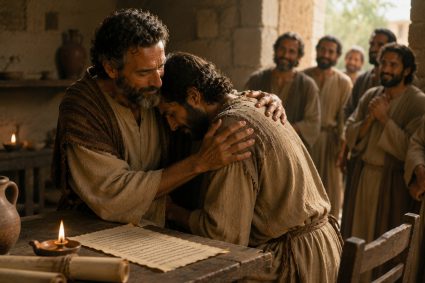
The passage about forgiveness is especially profound. Paul does not want the guilty person to be overwhelmed by excessive sorrow. This shows how earnestly the gospel seeks restoration. It is not enough to correct sin; the way back must also be opened. Some people are forever reduced to their guilt after making a mistake. Paul opposes this attitude. Where repentance is present, love should be reaffirmed. Forgiveness must become visible.
This also challenges our personal hearts. Perhaps there are people whose guilt we continue to hold against them. Perhaps we have officially forgiven, yet inwardly we continue to maintain distance, distrust, or old accusations. Paul reminds us that Satan can destroy not only through sin, but also through unforgiving harshness after repentance has taken place. Where love is no longer willing to forgive, the gospel becomes obscured.
The spiritual depth of this lesson is also evident in the fact that Paul continues to look to Christ despite his anxiety. In Troas, a door was opened to him, but he had no rest in his spirit because Titus was not there. Ministry and inner unrest existed side by side. This is also realistic. Those who love people are not unaffected by their condition. Spiritual maturity does not mean no longer feeling anything, but bringing our concerns, pain, and unanswered questions to Christ.
When Paul finally received good news, he thanked God. He did not view the fruit as his own victory, but as Christ’s triumph. This protects us from pride. When God works through our ministry, the glory belongs to Him. When people repent, relationships are healed, and churches are rebuilt, this is not a reason for self-exaltation, but for praising God.
The “fragrance of Christ” is a powerful image for our lives. Every Christian spreads something. Our words, the way we deal with guilt, our response to misunderstandings, our willingness to forgive, and our sincerity either make Christ visible or conceal Him. The question is not merely whether we speak about Jesus, but whether His character can be sensed through us.
This lesson therefore invites us to a ministry that draws its life from Christ. It does not arise from harshness, vanity, fear of people, or a desire for control, but from comfort, truth, mercy, and hope. Such ministry is not always easy, but it bears fruit because Christ Himself sustains it.
In the end, a great encouragement remains: God can also use difficult paths. The tearful letter, the changed plans, the concern for Titus, the tension with Corinth, and the painful correction became instruments of healing in God’s hand. What was distressing from a human perspective became spiritually fruitful. This is the triumph of Christ: He transforms pain into ministry, correction into restoration, anxiety into joy, and weak servants into witnesses of His grace.
🔧 7. Application in Everyday Life
Practical steps:
- Do not seek God’s comfort only for yourself, but ask whom you can serve with the comfort you have received.
- Examine your motives before God and ask Him for integrity and sincerity.
- Do not act impulsively during conflicts, but ask what will truly benefit the other person spiritually.
- Be willing to change your plans when love and wisdom require it.
- Take sin seriously, but do not reduce people to their failures.
- Forgive where genuine repentance is evident, and reaffirm your love in practical ways.
- Do not allow worry and inner unrest to turn you away from serving Christ.
- Give God the glory for every fruit produced through your ministry.
❓ 8. Reflection Question
Is my ministry shaped by the love of Christ so that others can experience comfort, honesty, forgiveness, and hope through me?
🌟 9. Closing Thought
Lesson 9 shows that ministry motivated by love is profound, sincere, and sometimes painful. Paul was comforted by God and was therefore able to comfort others. He acted with integrity and sincerity, changed his plans out of consideration, sought forgiveness and restoration, and remained a faithful proclaimer of Christ despite his concerns. His ministry was not focused on self-protection, recognition, or power, but on the spiritual well-being of the church. It was precisely in this that Christ’s triumph became visible. Those who live by God’s comfort and serve in the love of Christ become instruments through whom God encourages, heals, and brings people back to Himself.
“Now thanks be unto God, which always causeth us to triumph in Christ, and maketh manifest the savour of his knowledge by us in every place.”
2 Corinthians 2:14 📌🔥✝️🙏
