











🌅 BACK TO THE SOURCE OF LIFE
Sabbath reflections for stillness, renewal, and an encounter with God
🌿 Encounters with Jesus
🌳 2. Zacchaeus
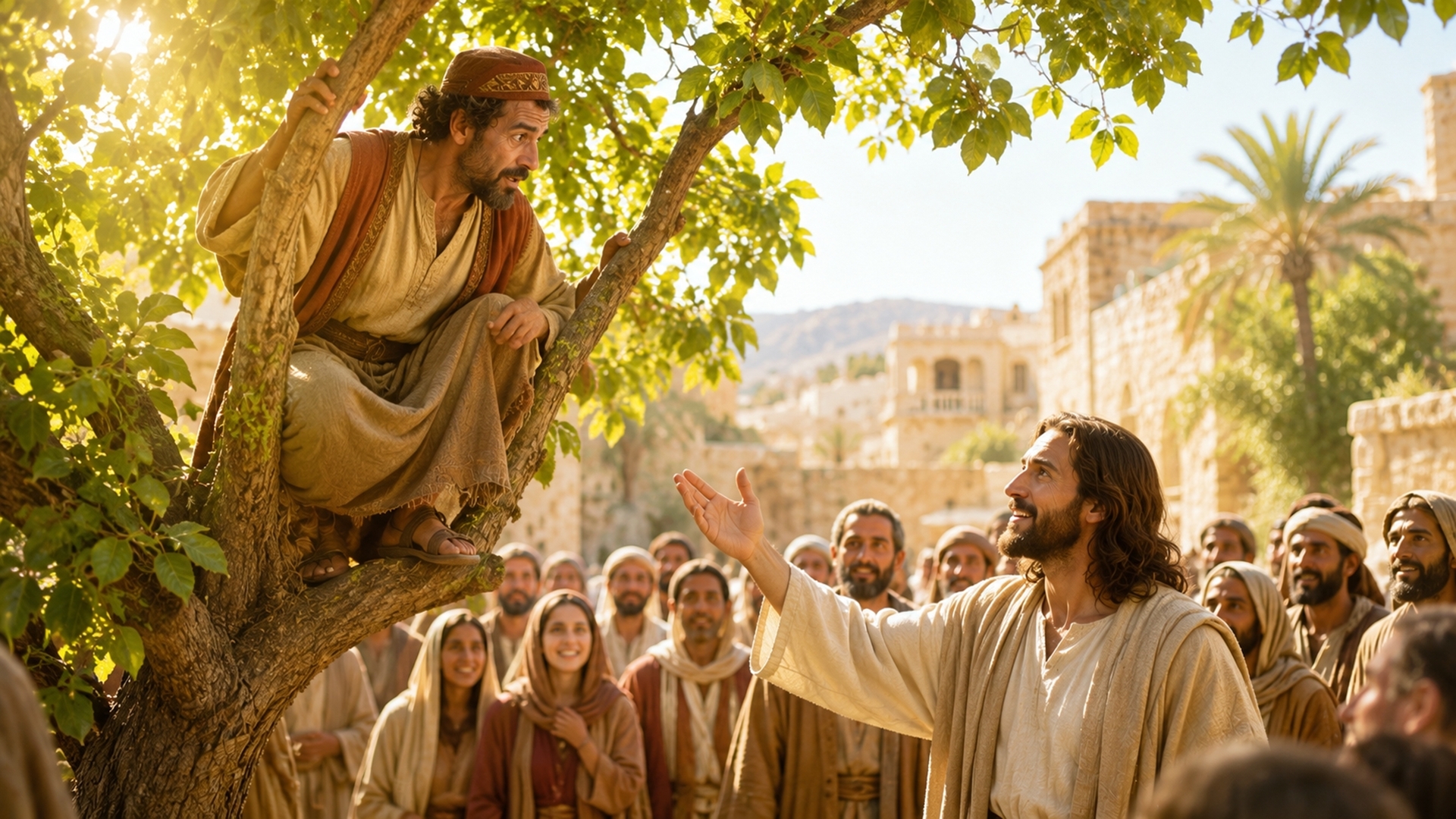
“And when Jesus came to the place, He looked up and saw him, and said to him, ‘Zacchaeus, make haste and come down, for today I must stay at your house.’”
Luke 19:5
🕊️ A Story – A Man Who Was Searching for More Than He Could Admit
Jericho was one of the most important cities along the road to Jerusalem. Its location and active commerce made it prosperous, and wherever goods were transported and business was conducted, taxes were also collected. Zacchaeus had found his position within this system. Luke does not describe him merely as a tax collector, but as a chief tax collector, adding explicitly that he was rich. Zacchaeus was therefore not an insignificant man living on the margins of society. He possessed influence, responsibility, and probably far more material security than most of the people he encountered each day.
Yet his occupation made him a despised man among his own people. Tax collectors worked for the Roman occupying power and were able to demand money beyond the officially established taxes. Whatever additional amount they collected, they could keep for themselves. The entire system was therefore vulnerable to exploitation and personal enrichment. A Jew who worked within this system was consequently regarded not only as dishonest, but often also as a traitor to his own people.
Zacchaeus had built a successful career within this system. He had attained what many people would consider desirable: wealth, influence, and financial security. At the same time, however, Luke allows us to recognize that none of this had satisfied a deeper longing. When Zacchaeus heard that Jesus was passing through Jericho, he urgently wanted to discover who this Jesus was.
Perhaps he had already heard many things about Him. News about Jesus had long since spread throughout the land. People spoke about His healings, His parables, and His message about God’s kingdom, which sounded different from much of what they were accustomed to hearing. Something else, however, must have held particular significance for Zacchaeus: Jesus was not afraid of tax collectors. One of His own disciples, Matthew, had himself been a tax collector before Jesus called him to follow Him. Jesus had eaten with people whom religious society avoided and had repeatedly been criticized for doing so.
Perhaps Zacchaeus had allowed himself to consider for the first time that this Jesus might also have a message for someone like him. He wanted to see Him.
When he reached the street through which Jesus was expected to pass, however, a crowd stood in his way. Luke mentions a seemingly incidental detail: Zacchaeus was short in stature. Surrounded by the densely packed people, he could not see Jesus. A man of his social position could easily have ended the matter there. He could have returned home and told himself that the opportunity had simply passed.
By then, however, the longing within him had become stronger than his concern for preserving his dignity. Zacchaeus ran ahead and climbed into a sycamore tree standing beside the road. This was hardly dignified behavior for a wealthy chief tax collector. An adult man of his rank would not normally run through the streets, much less climb a tree like a child. At that moment, however, being able to see Jesus had apparently become more important than controlling the impression he made upon others.
A genuine encounter with God sometimes begins precisely at this point: a person stops protecting their outward appearance because the longing for something real has become stronger.
🌿 When Longing Overcomes Pride
Zacchaeus had not yet spoken with Jesus. He had not made a public confession or put his past in order. He had simply made one decision: he wanted to see Jesus and was prepared to do something that others might consider ridiculous.
This already contains an important spiritual truth. God often begins His work within a person’s life long before the outward transformation becomes visible. Inner unrest, questions about the meaning of one’s life, a new longing for God, or the realization that one’s present path does not bring genuine fulfillment can all indicate that the Holy Spirit is already working upon the heart.
From the outside, people would probably have judged Zacchaeus differently. They saw his wealth and occupation. They may have known of occasions when he had demanded too much money, and some of them may personally have suffered because of his actions. They had long since decided into which category this man belonged.
Jesus, however, saw more deeply.
This does not mean that Zacchaeus’s guilt was unimportant to Him. The rest of the story will show that an encounter with Christ had concrete consequences for Zacchaeus’s conduct and his relationship with money. Jesus, however, saw more than what Zacchaeus had become. He also recognized a heart in which the desire for transformation had already begun to grow.
In her account of this encounter, Ellen G. White explains that Zacchaeus had already been touched by the message of Jesus and that a longing for a different life had begun to develop within him. The news that Christ did not despise tax collectors had given him hope. Even before Jesus stopped beneath his tree, something had already begun to move within this man’s heart.
This is important because we can usually judge only the visible condition of other people. We do not know what conversations God has already been conducting with their hearts. A person may still appear outwardly far from God while inwardly beginning to search for Him. We should therefore be very cautious about spiritually dismissing anyone. The story of Zacchaeus reminds us that Christ sees possibilities that remain completely hidden from everyone else.
🔥 When Success Cannot Satisfy the Inner Hunger
This story also confronts us with an uncomfortable question: How much of what we pursue each day can actually satisfy our hearts? Zacchaeus had attained money, position, and influence, yet he was still willing to climb a tree simply to catch a glimpse of Jesus. Something was missing that his wealth could not replace.
Material possessions are not automatically evil in the Bible. The problem begins when we expect possessions, success, or recognition to provide the value and peace that only a relationship with God can give. A person can then possess many things outwardly while remaining inwardly poor.
Zacchaeus must have known this tension well. His profession had probably given him a high standard of living, but it had simultaneously damaged relationships and created distrust. The very thing that had given him security had also separated him from other people. Perhaps he had believed for years that the next profit, a better position, or still greater wealth would eventually be enough. Now he was sitting in a tree, waiting for a traveling preacher from Galilee.
The picture is almost paradoxical: the rich man sits hidden among the branches, waiting for Someone who had said that the Son of Man had nowhere to lay His head. One possessed a large house, but his heart was searching for peace; the other possessed hardly anything the world would call security, yet He could give Zacchaeus precisely what he longed to receive.
Perhaps one of the great questions within this encounter is this: What remains when everything we have achieved can no longer convince our hearts?
Zacchaeus did not begin by answering this question theoretically. He did something much simpler: he placed himself where he could see Jesus.
🌙 Jesus Draws Near
From his place among the branches, Zacchaeus could observe the crowd. Perhaps he initially saw Jesus only from a distance. Step by step, Jesus came closer, accompanied by people who wanted to see, hear, or touch Him. Zacchaeus probably thought he knew how the encounter would end: Jesus would pass beneath the tree, he would see Him for a few moments, and afterward he would climb down and return home. Apparently, he expected nothing more.
When Jesus reached the tree, however, He did not continue walking. He stopped, and this brief pause carried profound significance. Jesus was not standing by chance beneath just any tree. He looked up and saw Zacchaeus. The man who had found a place from which he could observe unnoticed suddenly discovered that he himself was being seen.
Then he heard his name:
“Zacchaeus, make haste and come down, for today I must stay at your house.”
(Luke 19:5)
Zacchaeus had wanted to see Jesus. Now he discovered that Jesus had already seen him.
He may have hoped to learn something about this unusual Teacher from a safe distance, but Jesus transformed his observation into a personal encounter. He did not merely say, “I know you are there,” but announced that He would come into his house.
This must have shocked the people standing nearby. Jericho undoubtedly contained many homes whose owners were more religiously respected than Zacchaeus. There were people with better reputations who perhaps would have welcomed Jesus enthusiastically. Yet Christ chose the house of the chief tax collector.
This revealed the meaning of grace. Jesus did not wait until Zacchaeus had completely transformed his life before drawing near to him. Instead, His presence created the very place in which transformation could begin.
🌿 “Today I Must Stay at Your House”
One expression in the words of Jesus is especially striking: “today.” Jesus was not speaking about some indefinite future. He did not tell Zacchaeus to fulfill certain conditions first and then seek Him again. The encounter was to take place immediately.
Even more remarkable is the word “must.” Jesus said, “Today I must stay at your house.” This gives the encounter a depth that reaches beyond a spontaneous invitation. Zacchaeus was not an inconvenient interruption on Christ’s journey to Jerusalem. This man was part of His mission.
At the end of the story, Jesus Himself would explain:
“For the Son of Man has come to seek and to save that which was lost.”
(Luke 19:10)
Looking back, we can understand what happened beneath the tree. Zacchaeus thought that he was the one searching, but Jesus was actually the One seeking him.
This reversal belongs to the heart of the gospel. We often speak about a person searching for God, and that is true. Behind every genuine longing for God, however, stands a God who first sought the person. Zacchaeus ran ahead, climbed the tree, and wanted to see Jesus. Christ, however, knew his name, stopped beneath his tree, and brought the encounter into a place where Zacchaeus himself would never have dared to lead it: his own home.
Part 2 reveals what happens when Jesus is not merely observed from a distance, but genuinely welcomed. The people complain because Christ enters the home of a “sinner,” while Zacchaeus discovers that the grace which accepts him does not leave his life unchanged. His relationship with money, with the people he has wronged, and ultimately with his entire past is transformed.
The decisive movement, however, has already begun: The man in the tree has been called down because Jesus does not merely want to be seen; He wants to meet him personally.
🕊️ When Jesus Entered the House
Zacchaeus quickly climbed down from the tree and received Jesus joyfully. Luke describes this transition with great simplicity, but therein lies its power. The man who had just been observing from a safe distance now opened his own home. Curiosity became closeness, observation became fellowship, and a brief glimpse of Jesus became an encounter that reached into the most hidden areas of his life.
The crowd responded very differently. When the people saw where Jesus was going, they began to complain: “He has gone to be a guest with a man who is a sinner.” They had already placed Zacchaeus into a fixed category. His past, occupation, and reputation determined their judgment, which made Christ’s decision incomprehensible to them. In their eyes, a person first needed to change before becoming worthy of fellowship with a religious teacher.
Jesus acted in exactly the opposite way. He did not wait for the transformation; His presence brought it about.
This does not mean that Jesus minimized Zacchaeus’s guilt. He did not say that fraud was insignificant or that injustice did not matter. He knew, however, that genuine repentance rarely grows out of humiliation. It develops where a person realizes that God knows them completely and nevertheless does not turn His back upon them.
Something therefore happened in the home of Zacchaeus that began almost invisibly. Perhaps they ate together, perhaps they spoke, or perhaps Zacchaeus simply listened to Jesus. Luke does not record a long sermon or describe an extensive conversation. Instead, he shows us the result: the encounter with Christ had reached the chief tax collector’s heart.
🌿 Grace That Does Not Make Us Comfortable
At some point during this encounter, Zacchaeus stood and said to Jesus:
“Look, Lord, I give half of my goods to the poor; and if I have taken anything from anyone by false accusation, I restore fourfold.”
(Luke 19:8)
These words reveal that Christ’s grace did not merely reassure Zacchaeus; it transformed him. He did not simply begin to think differently about himself. He suddenly viewed his money, his decisions, and the people he may have wronged in an entirely new way.
This is an important characteristic of genuine repentance: it does not remain confined to feelings, but becomes concrete.
Zacchaeus did not merely want to say that he regretted his past. He was prepared to accept responsibility. Wherever he had harmed people, he wanted to make restitution. Where he had accumulated possessions, he wanted to learn to give. What had previously served his own advantage acquired new meaning through his encounter with Jesus.
This is why the story is so far removed from a superficial understanding of grace. Jesus accepted Zacchaeus before he had put his life in order, but this acceptance did not leave him as he was. Grace and truth did not stand in opposition to one another. The love of Christ gave Zacchaeus the courage to face the truth about his own life.
In her account of this encounter, Ellen G. White emphasizes that genuine conversion becomes visible when a person is prepared, as far as possible, to make amends for wrongs committed. Repentance does not remain abstract, but transforms the practical way a person relates to possessions, responsibility, and other people. (See Ellen G. White, The Desire of Ages, chapter on Zacchaeus.)
🔥 When Possessions Lose Their Power
Only a few hours earlier, Zacchaeus had been known as a wealthy chief tax collector. Wealth was part of his identity. Now he voluntarily began giving away a large portion of his possessions.
What had happened?
Jesus had not told him that money itself was worthless, but in Christ’s presence, possessions lost their power over his heart. Zacchaeus discovered something more valuable than everything to which he had previously clung.
This may be one of the deepest transformations Christ can produce within a person. He does not always remove things from our lives, but He gives them their proper place. Possessions may remain possessions, success may remain success, work may remain work, and recognition may remain recognition, but they must no longer assume the place that belongs to God alone.
For years, Zacchaeus may have attempted to gain security through money. Now he found security within a relationship. He had probably protected himself through influence, but now he could let go. He may have believed that he needed to possess more in order to be worth more. Now he began to understand that his value did not lie in what he possessed, but in the One who had sought him.
This is precisely why generosity suddenly became possible. Those who cling to their lives out of fear find it difficult to give, but those who have discovered that God sustains them no longer need to hold tightly to everything.
🌙 “Today Salvation Has Come to This House”
Jesus responded to Zacchaeus’s declaration:
“Today salvation has come to this house, because he also is a son of Abraham.”
(Luke 19:9)
With these words, Jesus publicly restored something society had long denied Zacchaeus. The people regarded him as a traitor and sinner, but Jesus reminded them that this man also belonged to the family God had called.
The expression “son of Abraham” was more than a genealogical designation. It made clear that Zacchaeus did not stand beyond the reach of God’s promise. His past had not placed him outside what God could accomplish.
Jesus then explained the meaning of the entire encounter:
“For the Son of Man has come to seek and to save that which was lost.”
(Luke 19:10)
This is the key to the story.
Zacchaeus was not saved because he had climbed a tree, nor was he saved because he distributed his money. His generosity was the fruit of what had already happened: Christ had sought, found, and accepted him. Salvation had come to him, and this encounter transformed his conduct.
The order is decisive: not, “Change yourself so that Jesus will come to you,” but, “Allow Jesus to come to you, and His presence will transform you.”
🌾 The Sabbath – When Christ Desires to Enter Our Home
The story of Zacchaeus possesses special depth for the Sabbath because it reminds us that God does not merely claim a portion of our time, but seeks fellowship with us. Jesus did not want simply to pass by Zacchaeus. He wanted to enter his house. This provides a beautiful picture of the Sabbath: God gives us sacred time in which He is not meant to be observed from a distance, but welcomed into our lives.
We can prepare for the Sabbath very carefully in outward ways. We can finish our work on time, put the house in order, prepare food, attend the worship service, and make sure that the day differs from the rest of the week. All these things can express love and reverence. The story of Zacchaeus, however, raises a deeper question: Have we merely prepared for Christ on the Sabbath, or have we genuinely opened the door of our hearts to Him?
It is possible to observe a sacred day while still keeping Jesus at a distance. We can read about Him, sing hymns, and uphold correct convictions while leaving certain areas of our lives untouched. Perhaps there are habits we protect from Him, relationships in which we are unwilling to reconcile, worries we refuse to surrender, or decisions regarding which we would prefer not to hear His voice.
At first, Zacchaeus had only wanted to see Jesus. Christ, however, said, “Today I must stay at your house.” Week after week, the Sabbath presents us with the same invitation: God does not merely want to be observed, but welcomed.
The rest of the Sabbath creates space for precisely this encounter. During the week, it is easy to avoid deeper questions. Work, appointments, and responsibilities can cover what remains unresolved within the heart. On the Sabbath, much of this falls away, and within this stillness, God’s presence can touch areas we otherwise avoid.
Perhaps He shows us that we have wronged someone. Perhaps He reminds us of a conversation that should have taken place long ago. Perhaps He makes us aware that our relationship with money, success, or recognition has occupied too much space. He may also show us how deeply we have allowed ourselves to be controlled by the opinions of others.
The Sabbath then becomes not merely rest, but renewal.
Jesus did not enter Zacchaeus’s house simply to create a pleasant religious atmosphere. His presence brought truth into the open. Zacchaeus suddenly began to think very concretely about his life. Whom had he harmed? What needed to change? What could he return? Where was restitution possible?
Our Sabbath rest may possess this same depth. Resting before God does not mean that every uncomfortable question becomes silent. Sometimes it is precisely within the stillness that we hear what was drowned out during the week. When Christ addresses these matters, however, He does not do so to humiliate us, but because He desires to give us freedom.
The Sabbath also reminds us that our value is not earned through performance. For six days, we live in a world where much depends upon what we accomplish, possess, or attain. The Sabbath interrupts this logic. We stop working and thereby confess in a practical way: My life does not depend solely upon my productivity. I am not valuable because I have accomplished enough. I belong to God before I have anything to show Him.
This is precisely what Zacchaeus experienced. Jesus sat at his table before Zacchaeus had begun making restitution. Fellowship was a gift, and transformation grew from that gift.
In the same way, the Sabbath is grace before it is a duty.
We do not enter this day because we did everything correctly during the past week. We enter because God calls us. Perhaps we come with mistakes, fatigue, unresolved conflicts, and a week that unfolded differently from what we had hoped. Christ does not say, “Put everything in order first and come afterward.” He invites us into His presence so that transformation can begin there.
At the same time, the Sabbath must not become an isolated spiritual island. What Zacchaeus recognized in the presence of Jesus had consequences for the following day. When we experience God’s grace on the Sabbath, that grace should also shape our daily lives. It may transform the way we speak, handle money, treat people, offer forgiveness, and accept responsibility.
A Sabbath that merely gives us a pleasant evening without touching anything within our lives falls short of its true richness. God gives us this sacred time so that an encounter with Him can realign us and enable us to enter the coming week differently.
Perhaps one of the most important questions of this Sabbath is therefore not whether we have prepared everything correctly, but whether we are ready to hear Jesus say:
“Today I want to stay with you.”
🤲 Invitation
Take time this Sabbath not only to tell Christ about your life, but consciously to give Him room within it. Ask Him whether there is an area you have kept at a distance until now. Perhaps it concerns your treatment of another person, your priorities, your time, your possessions, or something from your past that remains unresolved.
You do not need to hide from Him. Jesus already knew Zacchaeus before He stood beneath the tree. Nevertheless, He called him by name and went home with him.
His knowledge of the truth about us does not prevent Him from drawing near; it becomes the place where His grace can begin its work.
✨ Prayer
Lord Jesus, I thank You that You do not merely pass people by, but seek them and call them by name. You know me completely and understand what is visible within my life as well as what I would prefer to keep hidden. Nevertheless, You invite me to draw near to You.
Enter my life anew this Sabbath. Show me where my heart is clinging to things that cannot give me genuine security and where I have postponed changes You have long desired to bring about within me. Give me the courage not to experience truth as a threat, but as part of Your liberating grace.
If I have wronged someone, teach me to accept responsibility. If possessions, success, or recognition have taken too much space within my life, reorder my priorities. Allow the rest of this Sabbath to reach not only my body, but also my thoughts, decisions, and relationships.
Thank You that I do not need to earn Your love. You come to meet me before I have put everything in order, and Your presence gives me the strength to live differently. Let this encounter produce fruit that remains visible even after the Sabbath has ended.
When I feel small, unworthy, or far away, remind me that even today You continue to seek and save those who are lost.
Amen.
